

Guide
Socket Set Sizes: SAE and Metric Chart
Socket set sizes in SAE and metric, with mm equivalents, drive sizes and 6-point vs 12-point. Pick the exact size so you do not round off a fastener.

In this guide
- SAE vs metric sockets
- Socket size chart: SAE to mm
- Socket conversion chart: metric to nearest SAE
- Drive sizes: 1/4, 3/8, 1/2 and 3/4 in
- 6-point vs 12-point sockets
- Standard vs deep sockets
- Impact sockets vs hand sockets
- Common socket mistakes
- Socket set sizes: how to choose a starter set
- How to standardize and reorder
- Our picks
- Shop the products in this guide
Quick answer: Socket set sizes come in two systems. SAE sockets are fractions of an inch (1/4 in to 1 in is the usual range) and metric sockets are in millimeters. To compare them, multiply inches by 25.4. Some pairs look close but are not the same, so use the exact size for the fastener.
- Drive sizes: 1/4 in for small fasteners, 3/8 in for general work, 1/2 in for larger fasteners, 3/4 in for heavy-duty
- SAE to mm: 3/8 in = 9.53 mm, 1/2 in = 12.70 mm, 3/4 in = 19.05 mm
- 6-point grips the flats best; 12-point engages faster
- Impact sockets are for impact tools; hand sockets are not
Knowing socket set sizes saves you from buying the wrong set and from rounding off a fastener with the wrong socket. This guide is for maintenance crews, fleet and auto shops, contractors, facility managers and anyone ordering sockets by the set or by the single size. It covers SAE versus metric, an SAE-to-millimeter chart, a metric-to-nearest-SAE chart, drive sizes, point count, depth, impact versus hand sockets and how to pick a starter set. The products mentioned are in the Sockets and Ratchets collection.
Shop the 8 products in this guide
SAE vs metric sockets
Every socket has two sizes, and they are easy to mix up.
- Fastener size. The distance across the flats of the bolt head or nut the socket fits. It is stamped on the socket, in fractions of an inch (SAE) or in millimeters (metric).
- Drive size. The square hole where the ratchet or extension connects. It is 1/4 in, 3/8 in, 1/2 in or 3/4 in, and it has nothing to do with the fastener size.
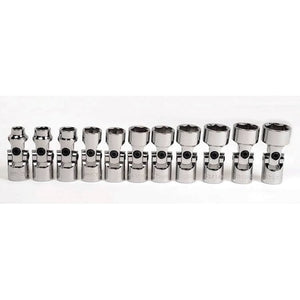
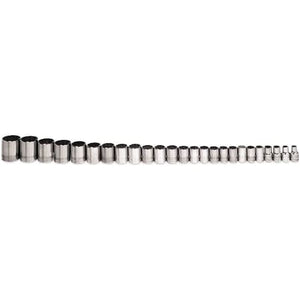
SAE sockets, often called standard or inch sockets, step up in sixteenths of an inch for common sizes. Metric sockets step up in whole millimeters for common sizes. A set can be SAE only, metric only, or a combination set. A Williams JHW31939 universal set, for example, is a 3/8 in drive metric set of 11 pieces, while the Williams JHWWSS-23RC is a 1/2 in drive SAE set of 23 pieces.
If you service equipment from different makers, you will probably need both systems.
Socket size chart: SAE to mm
The table converts common SAE socket sizes to millimeters. The formula is inches x 25.4 = millimeters, rounded to two decimals, because one inch is defined as exactly 25.4 mm (NIST).
| SAE size (in) | Decimal (in) | Millimeters |
|---|---|---|
| 1/4 | 0.250 | 6.35 |
| 5/16 | 0.3125 | 7.94 |
| 3/8 | 0.375 | 9.53 |
| 7/16 | 0.4375 | 11.11 |
| 1/2 | 0.500 | 12.70 |
| 9/16 | 0.5625 | 14.29 |
| 5/8 | 0.625 | 15.88 |
| 11/16 | 0.6875 | 17.46 |
| 3/4 | 0.750 | 19.05 |
| 13/16 | 0.8125 | 20.64 |
| 7/8 | 0.875 | 22.23 |
| 15/16 | 0.9375 | 23.81 |
| 1 | 1.000 | 25.40 |
The exact sizes in a set differ, so check the contents on the product page.
Socket conversion chart: metric to nearest SAE
People often search a socket conversion chart because they have a metric socket and an inch fastener, or the reverse. The table below lists common metric sizes with the nearest SAE size from the chart above. The last column is the metric size minus the SAE size, in millimeters, so a plus sign means the metric socket is larger and a minus sign means it is smaller.
| Metric (mm) | Nearest SAE (in) | SAE in mm | Difference (mm) |
|---|---|---|---|
| 8 | 5/16 | 7.94 | +0.06 |
| 10 | 3/8 | 9.53 | +0.47 |
| 11 | 7/16 | 11.11 | -0.11 |
| 12 | 1/2 | 12.70 | -0.70 |
| 13 | 1/2 | 12.70 | +0.30 |
| 14 | 9/16 | 14.29 | -0.29 |
| 16 | 5/8 | 15.88 | +0.12 |
| 17 | 11/16 | 17.46 | -0.46 |
| 19 | 3/4 | 19.05 | -0.05 |
| 21 | 13/16 | 20.64 | +0.36 |
| 22 | 7/8 | 22.23 | -0.23 |
| 24 | 15/16 | 23.81 | +0.19 |
Near matches are not matches. A 13 mm socket on a 1/2 in head is 0.30 mm too large, and that play can round off the corners of the fastener. A 19 mm socket is only 0.05 mm smaller than 3/4 in, which sounds negligible, but it may not seat on a 3/4 in head, and forcing it can damage the socket or the fastener. Use the exact size for the fastener, and if you cannot tell whether a head is inch or metric seat the socket by hand before you put a wrench on it. If it rocks on the head, it is the wrong size.
To see the difference in the store, compare the Williams JHWSTM-1213, a 1/2 in drive 13 mm metric socket, with the Williams JHWST-614, a 1/2 in drive 7/16 SAE socket. Both use the same drive size, but they fit different fasteners.
Drive sizes: 1/4, 3/8, 1/2 and 3/4 in
Drive size controls which ratchets, extensions and adapters you can use, and it also sets how much force the socket system is designed for. The uses below are general guidance, and the tool maker's ratings always apply.
- 1/4 in drive. The small size. It suits small fasteners, electronics and equipment panels, and tight spaces where a bigger ratchet will not fit. Sockets and ratchets are compact and light.
- 3/8 in drive. The general-purpose size and a common first set. It covers most maintenance and mid-size fasteners, which is why many shops keep a 3/8 in set on every cart.
- 1/2 in drive. The size for larger fasteners and higher torque, such as suspension, equipment mounting and wheel hardware. Ratchets and breaker bars are longer and heavier.
- 3/4 in drive. Heavy-duty work on large fasteners and heavy equipment, with large sockets and long handles.
Adapters step a drive size up or down, but do not step a small ratchet up to a fastener that needs more force than the ratchet is rated for. Browse socket extensions and adapters for the connectors, and ratchets and breaker bars for the handles. A breaker bar gives you leverage for a stuck fastener without loading a ratchet mechanism.
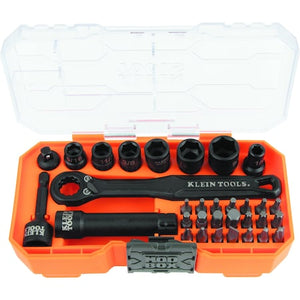
For small drives, the Klein Tools 65300 KNECT is a 1/4 in drive impact-rated pass through socket set of 32 pieces.
6-point vs 12-point sockets
The point count is the number of contact points inside the socket.
- 6-point. A hex shape that grips the flats of the fastener across a broad area. It is the better choice for stubborn, rusted or slightly worn fasteners because it is less likely to round the corners.
- 12-point. Has more points, so it can find the fastener head faster with less rotation of the ratchet. That helps in tight spaces where you cannot swing the handle far. It can also fit square and 12-point heads.
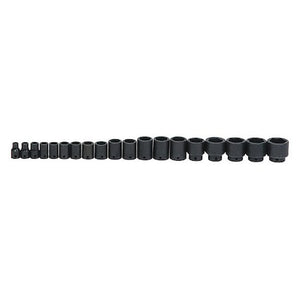
Neither is better for every job. Many people use 6-point for tight or stuck fasteners and 12-point for general work. The Williams JHWWSS-23RC is a 12-point 1/2 in drive SAE set, while the Williams JHWWS-4-19RC is a 6-point 1/2 in drive impact set of 19 pieces.
Standard vs deep sockets
A standard socket is short and fits a bolt head or nut with room to spare. A deep socket is longer, so it reaches a nut on a long stud or bolt, or a fastener recessed in a housing. A deep socket can be too long for shallow spaces. If you work on studs or recessed fasteners, make sure the set includes deep sockets.
Impact sockets vs hand sockets
Impact sockets are designed for impact wrenches and other impact drivers. They are typically black and have thicker walls. Chrome hand sockets are made for ratchets and breaker bars and are not designed for use on an impact tool. Never use a chrome hand socket on an impact tool, wear eye protection rated to ANSI Z87.1 when you run one, and follow the tool maker's instructions for the sockets that tool requires. You can use impact sockets on hand ratchets, but you cannot swap the other way.
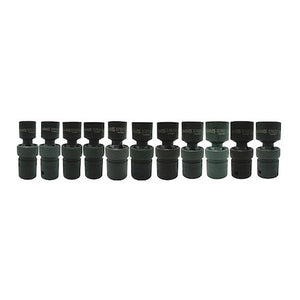
If you use impact tools, buy impact sockets. Shop impact sockets for the full range and hand sockets for ratchet and breaker bar work. Examples in the catalog include the Williams JHW4M-613, a 1/2 in drive 6-point 13 mm impact socket, and the Williams 37916, a 1/2 in drive universal impact socket set with 6-point sockets, 11 pieces.
Common socket mistakes
- Mixing up drive size and socket size. A 1/2 in drive socket may fit a 3/4 in or 19 mm fastener. Read both numbers.
- Chrome sockets on impact tools. Hand sockets are not built for impact use.
Socket set sizes: how to choose a starter set
- List your fasteners. Check whether the equipment uses inch fasteners, metric fasteners or both.
- Pick the drive size. A 3/8 in drive covers most general maintenance, with a 1/4 in set for small work and a 1/2 in set for larger fasteners.
- Choose the point count. Get 6-point sockets for rusted or stuck work and 12-point if you need fast engagement in tight spots.
- Decide on impact. If any impact tools are in use, buy impact sockets for them.
- Check what is in the set. Count the sockets, ratchets and extensions, and confirm the size range covers your fasteners.
The browse path is socket sets for kits, then single sockets to fill gaps. For hex and driver bits in a socket drive, see bit sockets and nut drivers.
How to standardize and reorder
Standardize on the drive sizes and size ranges your crew actually uses, and reorder missing sizes by part number rather than buying a new set each time a socket goes missing. Keep a short list of MPNs for each tray. To reorder by part number, use Quick Order. Orders of $79 or more ship free. Orders placed by 2 PM ET on a business day ship in 1-2 business days.
Our picks
- 1/4 in drive impact-rated pass through set: Klein Tools 65300 KNECT (MPN 65300). 32 pieces, for small fasteners and long studs.
- 3/8 in drive metric set: Williams JHW31939 (MPN JHW31939). Universal socket set, metric, 11 pieces.
- 1/2 in drive SAE set: Williams JHWWSS-23RC (MPN JHWWSS-23RC). 12-point, 23 pieces.
- 1/2 in drive SAE impact set: Williams JHWWS-4-19RC (MPN JHWWS-4-19RC). 6-point, 19 pieces.
- 1/2 in drive universal impact set: Williams 37916 (MPN 37916). 6-point, 11 pieces.
Browse every set and single size in Sockets and Ratchets.
Shop the products in this guide
-
$64.99
Ships in 1-2 business days
In stock
-
$337.49
Ships in 1-2 business days
In stock
-
$389.49
Ships in 1-2 business days
In stock
-
$351.99
Ships in 1-2 business days
In stock
-
$315.49
Ships in 1-2 business days
In stock
-

Williams
1/2" Drive Impact Socket Black Industrial, Standard 1/2" D, 6Pt, 13mm
MPN JHW4M-613
- MPN: JHW4M-613
$13.04
Ships in 1-2 business days
In stock
-
Williams
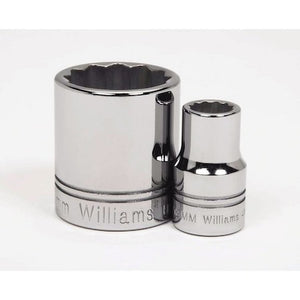
1/2" Drive, 13mm Metric Socket, 12 Points, Standard 1/2" D, 12Pt, 13mm
MPN JHWSTM-1213
- MPN: JHWSTM-1213
$13.42
Ships in 1-2 business days
In stock
-
Williams
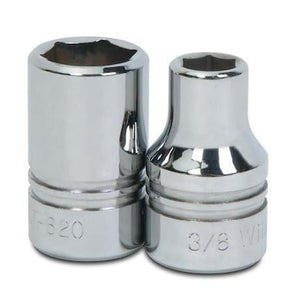
1/2" Drive, 7/16" SAE Socket, 6 Points, Standard 1/2" D, 6Pt, 7/16
MPN JHWST-614
- MPN: JHWST-614
$13.52
Ships in 1-2 business days
In stock

Frequently asked questions
What are the 3 socket sizes?
Most people mean the three common drive sizes, 1/4 in, 3/8 in and 1/2 in. The drive size is the square hole that fits the ratchet, not the size of the fastener. Larger 3/4 in drive sockets exist for heavy-duty work. Each socket also has its own fastener size, in inches or millimeters, stamped on the side.
What is the difference between SAE and metric sockets?
SAE sockets are sized in fractions of an inch, such as 7/16 or 1/2. Metric sockets are sized in millimeters, such as 10 mm or 13 mm. The two systems are built for different fasteners. Some sizes land within a fraction of a millimeter of each other, but they are not the same size.
Will metric sockets fit SAE bolts?
Not reliably. A few pairs are close, such as 19 mm and 3/4 in, which differ by 0.05 mm, but even a small gap can leave play or fail to seat. Loose sockets can round off the corners of a bolt head. Use the exact size for the fastener, not the nearest one.
What size socket set should I buy?
Match the fasteners you work on. A 3/8 in drive set covers most general maintenance, a 1/2 in drive set handles larger fasteners and more torque, and a 1/4 in set suits small fasteners and tight spots. Check whether you need SAE, metric or both, then add deep sockets and an extension.
How are socket sizes measured?
A socket is sized by the distance across the flats of the fastener head it fits, in inches for SAE or millimeters for metric. To convert, multiply inches by 25.4 to get millimeters. A 1/2 in socket is 12.70 mm. The size is stamped on the socket, and the drive size is separate.
How many sockets are in a socket set?
It depends on the set. The sets we list here run from 11 pieces to 32 pieces, and the count can include sockets, ratchets, extensions and adapters. Read the piece count and the contents on the product page, then confirm the size range covers the fasteners you actually service.
Guide
Grinding Wheel Types: Type 1, 27, Flap Discs and More
Grinding wheel types explained: Type 1, 27, 29, flap discs and wire wheels, plus grains, grit, arbor size...
Safety
Cut-Resistant Glove Levels: ANSI A1 to A9 Explained
Cut resistant gloves levels A1 to A9 explained: match the level to your task, read the ratings, compare...
Safety
Nitrile vs Latex vs Vinyl Gloves: Which to Choose
Nitrile vs latex vs vinyl gloves compared on allergy risk, puncture and chemical resistance, fit, cost and best uses.
New guides and deals by email
Buying guides, new products and deals for US businesses.