

Cut-Resistant Glove Levels: ANSI A1 to A9 Explained
Cut resistant gloves levels A1 to A9 explained: match the level to your task, read the ratings, compare coatings and know when to replace.

In this guide
- Cut resistant gloves levels at a glance: ANSI A1 to A9
- Choosing cut resistant gloves levels by task
- How to read a cut level rating
- Coatings and grip: nitrile foam, polyurethane, sandy nitrile and uncoated
- Sizing cut-resistant gloves
- When to replace cut-resistant gloves
- Standardize and reorder
- Our picks by cut level
- Shop the products in this guide
Quick answer: Cut resistant gloves levels run from A1 (lowest) to A9 (highest) under ANSI/ISEA 105. Match the level to the sharpest edge your crew touches: low levels for packaging and light handling, the middle of the scale for sheet metal, construction and glass, and the top for sharp scrap and blade contact. The level rates only the cut test. Puncture, abrasion, coating and fit are separate decisions.
If you are comparing cut resistant gloves levels for a crew, this guide shows how to choose the cut level by task, the buying decision: which level fits which task, how to read the rating on the product page, which coating suits your parts, and when to retire a pair. It is for safety managers, warehouse and maintenance supervisors, contractors and purchasing agents. For the full gram bands, old-scale conversions and EN 388 detail, see our ANSI cut level chart. Every glove below is in the Cut & Chemical Resistant Gloves collection.
Shop the 8 products in this guide
Cut resistant gloves levels at a glance: ANSI A1 to A9
ANSI/ISEA 105 sorts glove cut resistance into nine levels. The level comes from a straight-blade lab test (ASTM F2992, run on a TDM-100 machine): the more load the blade needs to cut through the material, the higher the level. A higher number means more cut resistance, and each level covers a range, so two A4 gloves can differ in their actual test result.
| Level | Grams to cut | Typical use (guidance only) |
|---|---|---|
| A1 | 200 to 499 | Nuisance cuts, light packaging |
| A2 | 500 to 999 | Warehouse picking, box cutters |
| A3 | 1,000 to 1,499 | Parts handling, light maintenance |
| A4 | 1,500 to 2,199 | General sheet metal, construction, fleet |
| A5 | 2,200 to 2,999 | Glass, stamping, heavier sheet metal |
| A6 | 3,000 to 3,999 | Metal fabrication, demolition |
| A7 | 4,000 to 4,999 | Sharp scrap, blade changes |
| A8 | 5,000 to 5,999 | Frequent sharp-edge contact |
| A9 | 6,000 and up | Direct blade and sharp metal contact |
These gram thresholds come from ANSI/ISEA 105, introduced in the 2016 edition. The current 2024 edition keeps the same A1 to A9 thresholds; see ISEA's hand protection classification key. Check which edition your PPE program or customer specification names. The uses in the table are typical buyer guidance, not a promise that a given glove stops a given edge.
Choosing cut resistant gloves levels by task
The right level is the lowest one that covers the hazard you actually found. A glove that is too heavy gets pulled off for fine work, and a glove in a pocket protects nothing.
| Task | Typical starting range | Grip and coating idea |
|---|---|---|
| Packaging, picking, box cutters | A1 to A3 | Polyurethane or uncoated, dry parts |
| General maintenance, light assembly | A2 to A4 | Polyurethane or foam nitrile |
| HVAC, sheet metal, construction | A4 to A5 | Foam or sandy nitrile |
| Auto and fleet, light oil | A4 to A5 | Sandy nitrile |
| Glass and metal stamping | A5 to A7 | Nitrile coat or uncoated knit |
| Sharp scrap, recycling, blade contact | A6 to A9 | Heavier reinforced liners |
Use the ranges as a first guess, then trial two or three gloves with the people who will wear them. A hazard assessment is how you confirm the choice, and OSHA 1910.132(d) requires a workplace hazard assessment, and 1910.138(b) bases glove selection on the hazards it identifies (more on that below).
A4 cut resistant gloves as a default
Many facilities set A4 as the minimum for anything with edges, then issue a higher level for named tasks only. That keeps one default part number in the closet and a short list of exceptions. The Ringers 065G-10 (MPN 065G-10) is listed at cut level A4 with a sandy nitrile coating, sold as a pair, which suits this default role for oily or dusty parts.
Low levels for warehouse and light handling
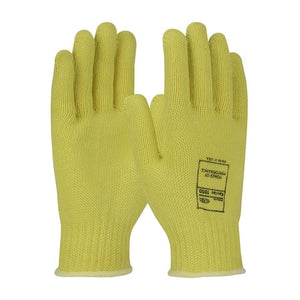
Thin gloves at A2 and A3 give the best feel for picking, scanning and opening cartons. The Hexarmor 2068X-XL (MPN 2068X-XL) is listed at cut level A2 with a polyurethane dip in XL, sold as a pair. The PIP 07-K350/M (MPN 07-K350/M) is listed at A3, uncoated, in a pack of 12, which suits crews that go through liners quickly.
Higher levels for heavy sheet metal and glass
Heavier stock and sharper edges push buyers toward A5 and above. Within that range the coating matters as much as the number, because a high-level glove that cannot hold an oily panel is a drop hazard. The picks section below lists A5, A6 and A7 gloves from the store.
How to read a cut level rating
Reading a glove's marking is mostly about what the number does not tell you.
- Cut, puncture and abrasion are separate ratings. A glove can be A6 for cut and weak for puncture. If the task involves needles, nails or wire ends, check the puncture rating on its own line.
- The level is a range. Two gloves with the same A code can test differently inside that band.
- Coverage matters. A cut-resistant palm on a plain knit back protects the palm only.
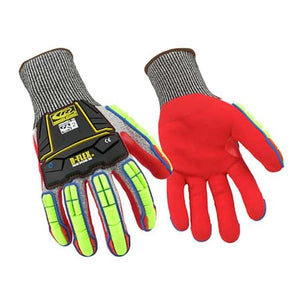
- Impact is a different test. Back-of-hand impact protection is rated apart from cut. An impact glove such as the Ringers R080 is listed in the store data at cut level A6 with a nitrile coating, size L, sold as a pair, but check the product page for its impact marking if that is why you are buying it.
- Powered blades are a different hazard. Cut-resistant gloves are not made for contact with powered blades such as saws and grinders. Check the maker's warnings.
ANSI levels vs EN 388
Gloves sold in the US and Europe often carry an EN 388 mark beside the ANSI mark. EN 388 reports cut on its own scale: in the 2016 edition, a letter from A to F from the ISO 13997 straight-blade test, which reports in newtons, plus a separate 1 to 5 score from a rotating-blade coup test. An EN 388 letter and an ANSI A level are not interchangeable. Use the rating the manufacturer states for the standard your PPE program names, and do not convert between them. The crosswalk in our cut level chart guide explains why such conversions are only rough.
What the product page tells you
Our product titles state the cut level the manufacturer lists, for example "Cut Level A4". Treat that as the starting point and confirm the rating, standard and coating on the product page before you place a case order.
Coatings and grip: nitrile foam, polyurethane, sandy nitrile and uncoated
The cut level on the listing applies to that glove as the maker tested it, so compare levels glove by glove. The coating mainly decides grip, wear and how the glove handles oil.
- Polyurethane (PU). Thin and responsive, good for dry parts and fine handling. Wears faster on rough surfaces.
- Foam nitrile. Breathable with grip in light oil, a common choice for maintenance and fleet work.
- Sandy nitrile. A rougher finish that holds oily or wet parts, such as stamped panels and fasteners.
- Uncoated. Knit only. Used where dexterity matters most, for dry handling, or as a liner under another glove.
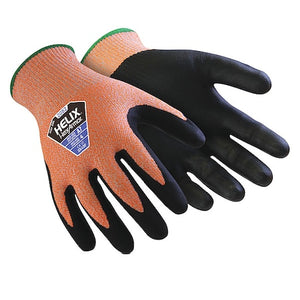
Match the coating to the surface first, then pick the level. A foam nitrile glove at A7 like the Hexarmor 2052-M (MPN 2052-M, listed with a foam nitrile sandy coating, size M, pair) suits oily sharp parts. An uncoated A7 like the Hexarmor 4045-XL (MPN 4045-XL, XL, pair) suits dry handling with fingertip feel.
If your hazard is a liquid, not a blade, you need a chemical-rated glove instead. Cut resistance and chemical resistance are different properties.
Sizing cut-resistant gloves
A loose cut-resistant glove bunches at the fingertips and slides on the palm, which cuts both grip and protection. Measure the dominant hand, pick the nearest size and order a few sizes for a mixed crew, each as its own line. Our work glove size chart lists how to measure and how brands label S, M, L and XL. Sizing varies by maker, so use the brand's own chart when it differs.
When to replace cut-resistant gloves
Cut-resistant gloves are not rated for a set number of shifts. Inspect them before each use and retire a pair when:
- The liner has been cut, or is thin, worn through or fuzzed at the fingertips.
- The coating is cracked, peeling or has lost grip.
- The glove is hardened, stiff or contaminated by oil, solvent or other residue that will not wash out.
- The cuff has stretched so the glove no longer stays put.
A worn glove may no longer perform as it did when tested. Write a replacement rule into your PPE program, and follow the manufacturer's care instructions for washing. OSHA 1910.138 requires employers to select hand protection based on the task, the conditions, the duration of use and the hazards identified. Read the rule on the OSHA hand protection page. OSHA does not name an ANSI level, so the level you choose is the one your hazard assessment supports.
Standardize and reorder
Pick one default level and one family of part numbers, then name the exceptions. A short glove list is easier to train on, stock and audit. Put each glove's MPN and size into your PPE program so the next purchaser reorders the right pair. Reorder by part number with Quick Order. Orders of $79 or more ship free. Orders placed by 2 PM ET on a business day ship in 1-2 business days.
Our picks by cut level
Store data lists these ratings. Confirm the cut level, standard and size on each product page before ordering.
| Glove | Listed cut level | Coating | Sold as |
|---|---|---|---|
| Hexarmor 2068X-XL | A2 | Polyurethane dipped | Pair, XL |
| PIP 07-K350/M | A3 | Uncoated | Pack of 12 |
| Ringers 065G-10 | A4 | Nitrile sandy | Pair |
| Ironclad SKC4SN-02-S | A5 | Nitrile sandy | Pair, S |
| Superior Glove S21TAXRFNB-9 | Up to A5 | Ultra thin | Pair |
| Ringers R080 | A6 | Nitrile | Pair, L |
| Hexarmor 2052-M | A7 | Foam nitrile sandy | Pair, M |
| Hexarmor 4045-XL | A7 | Uncoated | Pair, XL |
- Everyday A4 default: the Ringers 065G-10, MPN 065G-10.
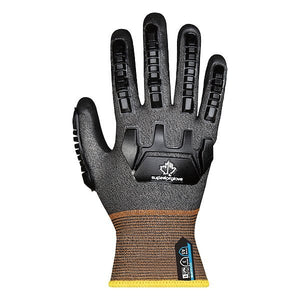
- Thin glove with up to A5 listed: the Superior Glove S21TAXRFNB-9, MPN S21TAXRFNB-9, an ultra thin style for work that needs feel.
- Oily sharp parts at A7: the Hexarmor 2052-M, MPN 2052-M.
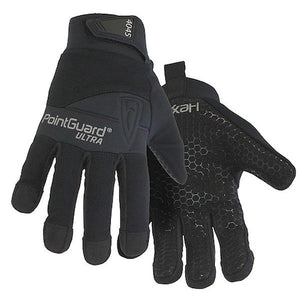
- Dry sharp parts at A7: the Hexarmor 4045-XL, MPN 4045-XL.
- Smaller hands at A5: the Ironclad SKC4SN-02-S, MPN SKC4SN-02-S.
Browse every level in Cut & Chemical Resistant Gloves, or see Gloves, Work Gloves and Safety & PPE for the wider range.
Shop the products in this guide
-
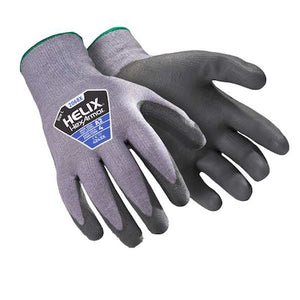
Hexarmor
Knit Gloves, Cut Level A2, Dipped, Polyurethane, Sandy, XL 1 Pair
MPN 2068X-XL (10)
- MPN: 2068X-XL (10)
$14.00
Ships in 1-2 business days
In stock
-
 Pack of 12
PIP
Cut-Resistant Gloves, Cut Level A3, Uncoated, M Pack of 12
MPN 07-K350/M
- MPN: 07-K350/M
- Pack of 12
$163.49
Ships in 1-2 business days
In stock
-

$34.52
Ships in 1-2 business days
In stock
-

Ironclad Performance Wear
Knit Work Glove, Cut Level A5, Nitrile, Sandy, S 1 Pair
MPN SKC4SN-02-S
- MPN: SKC4SN-02-S
$15.12
Ships in 1-2 business days
In stock
-
$25.32
Ships in 1-2 business days
In stock
-
Ringers Gloves
Cut Resistant Impact Glove, Cut Level A6, Nitrile, Size L (9), Pair
MPN R080
- MPN: R080
$77.52
Ships in 1-2 business days
In stock
-
Hexarmor
Knit Gloves, Cut Level A7, Dipped, Foam Nitrile, Sandy, M 1 Pair
MPN 2052-M (8)
- MPN: 2052-M (8)
$17.54
Ships in 1-2 business days
In stock
-
$73.38
Ships in 1-2 business days
In stock


Frequently asked questions
What level of cut resistant gloves do I need?
Start from the sharpest edge the worker touches and how long they touch it. Packaging and light handling often sit at the low levels, sheet metal and glass usually call for the mid to high levels. Your hazard assessment decides, so trial a glove on the real task before you standardize.
How many levels of cut resistant gloves are there?
ANSI/ISEA 105 defines nine cut levels, A1 through A9, with A9 the most cut resistant. Older spec sheets may show a numbered scale (levels 0 to 5 in the 2011 edition). The two scales do not map one to one, so rewrite old specs with the current A codes.
How are cut-resistant gloves rated?
In the US, the common method is ANSI/ISEA 105, which uses a standard straight-blade test (ASTM F2992) and assigns a level from A1 to A9. Puncture and abrasion are rated separately. Gloves sold in both markets may also carry an EN 388 mark, which uses a different scale.
Is an A4 glove enough for sheet metal?
Many crews treat A4 as a starting point for general sheet metal and construction, and move up for heavier stock, stamped parts or glass. This is typical guidance, not a guarantee. Check the glove on the actual task and record the choice in your hazard assessment.
How long do cut-resistant gloves last?
There is no fixed lifespan. Wear depends on the task, the surfaces handled and what the glove touches. Retire a glove when it has been cut, the liner is thin or fuzzed, the coating is cracked or peeling, or it is hardened or contaminated, and follow your employer's PPE program.
Safety
Nitrile vs Latex vs Vinyl Gloves: Which to Choose
Nitrile vs latex vs vinyl gloves compared on allergy risk, puncture and chemical resistance, fit, cost and best uses.

Safety & PPE
Work Glove Size Chart: How to Measure Your Hand (Numeric, S-XXL and EU Sizes)
Find your work glove size in 60 seconds.
Safety & PPE
ANSI Cut Level Chart: A1-A9 Cut-Resistant Gloves Explained
ANSI/ISEA 105 cut levels A1-A9 in one chart: grams per level, example jobs, old 1-5 and EN 388...
New guides and deals by email
Buying guides, new products and deals for US businesses.