


ANSI Z87.1 vs Z87+ Safety Glasses: How to Choose
BlinkGoods TeamFor ANSI Z87.1 safety glasses, look for the Z87 marking on the frame and the lenses. Z87 means the basic impact rating and Z87+ means the high-impact rating. Choose Z87+ for any job that throws chips, sparks or debris, add an anti-fog coating if you work in heat or wear a mask, and pick over-the-glass (OTG) glasses if you also wear prescription frames.
This guide is for facilities and shop managers, contractors, small business owners and home buyers who want to pick the right pair without reading the standard. You will find more styles in our Safety Glasses collection and the wider Safety & PPE department.
What ANSI Z87.1 covers
ANSI/ISEA Z87.1 is the American national standard for eye and face protection. The International Safety Equipment Association (ISEA) says the standard "prescribes the design, performance specifications, and marking of safety eye and face products." The current edition is ANSI/ISEA Z87.1-2025 (ISEA).
OSHA does not write its own glasses spec. Its eye and face rule, 29 CFR 1910.133, says protective devices must comply with ANSI/ISEA Z87.1-2010, ANSI Z87.1-2003 or ANSI Z87.1-1989 (R-1998), or be shown to be at least as effective (eCFR). In practice, buyers look for the Z87 marking and read the manufacturer's data sheet for the edition.
OSHA also sets two use rules that affect what you buy. Workers exposed to flying-object hazards need eye protection that provides side protection, and detachable side protectors are acceptable. Workers who wear prescription lenses need protection that incorporates the prescription or fits over it without disturbing the position of either lens (same rule, paragraphs (a)(2) and (a)(3)).
ANSI Z87.1 safety glasses: Z87 vs Z87+ markings
NIOSH explains the markings this way: eyewear is marked Z87 for normal safety wear and Z87+ for high impact. Prescription versions use Z87-2 and Z87-2+. Other letters can follow, such as D for dust, U for ultraviolet tint and R for infrared tint (NIOSH).
| Marking | Meaning | Examples (our guidance) |
|---|---|---|
| Z87 | Basic impact rating | Tasks where the hazard assessment finds no flying-object hazard |
| Z87+ | High-impact rating | Grinding, chipping, nailing, trimming, power tools |
| Z87-2 / Z87-2+ | Prescription versions of the same ratings | Safety glasses made with a prescription |
| D, U, R | Dust, UV tint, IR tint codes | Dust, UV and infrared hazards (check the data sheet for the exact code) |
Z87+ is the safer default. NIOSH also notes that because OSHA calls for side protection when flying objects are a hazard, nearly all safety glasses on the market are high-impact rated (same NIOSH bulletin).
One buying point matters here: a rating is only useful if you can see it. NIOSH notes the rating is required on both the frame and the lens, so read the marking on each. Our product listings usually show lens color, frame style and coating, but the title does not always show the Z87.1 marking, so confirm it on the product or the manufacturer data sheet before you issue glasses to a crew.
How to choose impact-resistant safety glasses
Match the glasses to the hazard first, then the comfort features.
- Impact hazard. If the job throws particles, use Z87+ glasses with side protection. Where your hazard assessment finds no flying-object risk, a basic Z87 pair may meet the need; when in doubt, choose Z87+.
- Lens. Clear lenses suit indoor work and inspection. Gray lenses cut glare outdoors. Our listings state the lens color in the title, for example the MCR Safety KD712PF in gray.
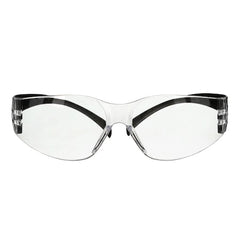
- Frame. Half frames are lighter. Wraparound frames add side coverage. Frameless designs such as the 3M SF101AF-BLK have no frame around the lens, which some wearers find more comfortable over a full shift.
- Fit. Glasses that slip get pushed up or taken off. Buy a few styles for a trial and let the crew choose.
- Coating. Check the product title and data sheet for anti-fog or anti-scratch coatings.
Clear lenses are the usual pick for indoor work in shops, labs and warehouses. Keep one gray-lens style for outdoor tasks.
Anti-fog safety glasses: when the coating is worth it
Fogging shows up when you work in heat, move between cold and warm areas, or wear a mask or respirator. An anti-fog coating lowers it. It does not remove it in every condition, and it has no effect on the impact rating.
Three listings show how manufacturers describe these coatings:
- The MCR Safety KD710AF is listed as anti-fog with a clear lens and a half frame.
- The MCR Safety KD712PF is listed with a MAX6 anti-fog coating and a gray lens.
- The 3M SF101AF-BLK is listed as anti-fog and anti-scratch with a clear lens and frameless design.
Coating names such as MAX6 are the manufacturer's own. Check the data sheet for what each coating covers and how to clean it. Clean coated lenses with a lens-safe cloth rather than a shop rag, following the manufacturer's instructions.
Over-the-glass safety glasses for prescription wearers
Over-the-glass (OTG) safety glasses are sized to sit over your own frames. A worker who wears prescription lenses has to either buy prescription safety glasses or wear protection that fits over them, which is what the OSHA rule above describes.
We carry several OTG options:
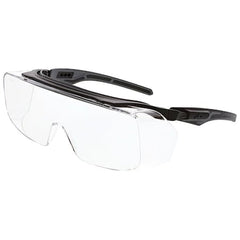
- The MCR Safety OG210PF is a Klondike OTG style with a MAX6 anti-fog coating and a clear lens.
- The MCR Safety OG220DC is also a Klondike OTG style, listed with a dual-coated MAX3/MAX6 lens.
- The Milwaukee Tool 48-73-2070 is listed as an OTG-wraparound, half-frame style with anti-fog and anti-scratch coatings and a clear lens.
Prescription safety glasses carry their own markings, Z87-2 and Z87-2+, as the NIOSH bulletin above explains. Try OTG glasses on over your own frames. If the temples press on the prescription frame or the lens sits at an angle, the pair is wrong for you, whatever the rating.
Safety glasses comparison
| Product | Listed features | Frame | Best for |
|---|---|---|---|
| 3M SF101AF-BLK | Anti-fog and anti-scratch, clear lens | Frameless, black | General indoor work |
| MCR Safety KD710AF | Anti-fog, clear lens | Half frame, black and gray | General shop and warehouse |
| MCR Safety KD712PF | MAX6 anti-fog, gray lens | Half frame, black and gray | Outdoor and bright areas |
| MCR Safety OG210PF | OTG, MAX6 anti-fog, clear lens | Half frame, black | Prescription wearers |
| MCR Safety OG220DC | OTG, dual-coated MAX3/MAX6, clear lens | Half frame, black and lime | Prescription wearers |
| Milwaukee Tool 48-73-2070 | OTG wraparound, anti-fog and anti-scratch, clear lens | Half frame | Prescription wearers who need a wraparound OTG |
| MCR Safety BKH15 | Clear lens | Not stated in listing | Spare or visitor stock (confirm the marking) |
The table states what each listing says. It does not state an impact rating, because the product titles do not. Check the Z87 or Z87+ marking when the glasses arrive.
Common mistakes when buying safety glasses
Trusting a coating more than a rating. An anti-fog or anti-scratch label says nothing about impact protection. Look for the Z87 or Z87+ marking.
Buying one style for everyone. Fit varies by face. A mixed crew needs two or three styles.
Skipping OTG for prescription wearers. Staff who wear their own frames under regular glasses leave them pushed up or off. Supply a pair that fits over them.
Ignoring the lens. Gray lenses indoors cut visibility. Clear lenses outdoors in bright sun cause squinting. Stock both.
Forgetting replacements. Scratched lenses scatter light and hide hazards. Replace them as part of a regular schedule.
Buying for a facility or at home
Home buyers can pick one Z87+ clear pair for each person doing yard work, woodworking or home repair, plus a gray pair for sunny jobs. Crews that need glasses usually need hearing protection and work gloves too. Businesses should standardize on two or three approved styles, keep a spare bin at each entrance for visitors, and reorder by SKU through Quick Order.
Order terms:
- Free shipping on orders of $79 or more, and $7.90 on orders under $79.
- Orders placed by 2 PM ET on a business day ship within 1-2 business days.
- Returns are accepted within 30 days of delivery. The customer pays return shipping, except for damaged, defective or wrong items.
- Net-30 terms are available for approved business accounts. Apply through Business Accounts.
- Tax-exempt purchasing is supported for eligible buyers.
Related guides: ANSI cut level chart, Work glove size chart and How to choose nitrile gloves for a facility.
Browse the full range in Safety Glasses.
Products in this guide
-
3M
3M SF101AF-BLK Safety Glasses, Anti-Fog & Anti-Scratch, Clear Lens, Black Frame, Frameless
MPN: SF101AF-BLK
$5.10Sold as: EachIn stock -
MCR Safety
MCR Safety KD710AF Klondike (KD7), Safety Glasses, Anti-Fog, Clear Lens, Black/Gray Frame, Half Frame
MPN: KD710AF
$10.48Sold as: EachIn stock -
MCR Safety
MCR Safety KD712PF Klondike (KD7), Safety Glasses, MAX6 Anti-Fog, Gray Lens, Black/Gray Frame, Half Frame
MPN: KD712PF
$13.36Sold as: EachIn stock -
MCR Safety
MCR Safety OG210PF Klondike (OTG), Safety Glasses, MAX6 Anti-Fog, Clear Lens, Black Frame, Half Frame
MPN: OG210PF
$14.68Sold as: EachIn stock
Frequently asked questions
What does Z87 mean on safety glasses?
Z87 is the marking for eyewear that meets the basic impact requirements of the ANSI/ISEA Z87.1 standard. Z87+ means the product also passed the high-impact tests. The marking should be on both the frame and the lenses, so look for it before you buy or issue a pair.
Is Z87+ better than Z87?
Z87+ is the higher impact rating, so it is the safer pick for grinding, chipping, nailing, trimming and other jobs that throw debris. Z87 is the basic rating. If a task has a flying-object hazard, choose Z87+ and check the manufacturer data sheet for the exact markings.
Do anti-fog coatings make safety glasses fogproof?
No coating removes fogging in every condition. A coating lowers it, and fit, airflow and temperature still matter. The coating does not change the impact rating, so confirm the Z87 or Z87+ marking separately.
Can I wear safety glasses over my prescription glasses?
Yes, if the safety glasses are made to go over them. OSHA requires employers to make sure workers who wear prescription lenses use eye protection that includes the prescription or fits over it without moving either lens. Over-the-glass (OTG) styles are built for the second option. Try them on with your own frames.
What are the shipping, return and payment terms?
Orders of $79 or more ship free, and orders under $79 pay $7.90. Orders placed by 2 PM ET on a business day ship within 1-2 business days. Returns are accepted within 30 days of delivery; the customer pays return shipping except for damaged, defective or wrong items. Net-30 terms are available for approved business accounts, and tax-exempt purchasing is supported.