

Guide
Grinding Wheel Types: Type 1, 27, Flap Discs and More
Grinding wheel types explained: Type 1, 27, 29, flap discs and wire wheels, plus grains, grit, arbor size and RPM checks before you buy.

In this guide
- Grinding wheel types and uses at a glance
- Cut-off wheels: Type 1, Type 41 and Type 27 cutting wheels
- Type 27 vs Type 1 grinding wheel: which one do you need?
- Type 27 vs Type 29, and flap discs
- Bench grinding wheel types and wire wheels
- Abrasive grains: which one for which metal
- Grit basics: coarse to fine
- How to match a wheel to your tool
- Safety basics for abrasive wheels
- Common mistakes
- Standardize and reorder
- Our picks
- Shop the products in this guide
Quick answer: The main grinding wheel types are Type 1 straight wheels and Type 41 flat cut-off wheels (cutting), Type 27 and Type 29 depressed center wheels (grinding with an angle grinder), flap discs (grinding and blending), vitrified bench wheels (stationary grinders) and wire wheels (cleaning). Pick the type for the job, match the grain to the metal, then confirm diameter, arbor size and a maximum RPM at or above your tool's speed.
Grinding wheel types differ by shape, bond and abrasive grain, and each one is built to be used in a specific way. Pick the wrong shape and you get slow cuts, a short wheel life or a wheel that is unsafe on the tool. This guide is for maintenance crews, fabricators, contractors and shop managers who order abrasives by part number. Every product named below is in our Grinding and Cut-Off Wheels collection or a related one.
Shop the 8 products in this guide
Grinding wheel types and uses at a glance
The Type number is the wheel shape code used in ANSI B7.1 and on wheel labels. These are the shapes you will meet most often on angle grinders and bench grinders.
| Type | Shape | Best for |
|---|---|---|
| Type 1 | Flat, straight, thin to medium | Cutting with the edge, or grinding on the edge on a stationary machine |
| Type 41 | Flat, thin cut-off wheel | Cutting bar, tube, sheet and angle |
| Type 27 | Depressed center, flat profile | Grinding flat surfaces and welds with the face |
| Type 29 | Depressed center, conical (high crown) | Grinding at an angle, blending and fillet welds |
| Type | What not to do |
|---|---|
| Type 1 and Type 41 | Do not side-grind with a thin cut-off wheel. Use only the face or edge the wheel is rated for |
| Type 27 | Do not use it for deep cutting unless the label rates it for cutting |
| Type 29 | Do not run it past the angle and pressure the maker allows |
| Flap disc | Do not treat it as a cutting wheel |
| Wire wheel | Do not skip eye and face protection, loose wire can fly off |
Always follow the markings printed on the wheel label. The label overrides any general rule, including the ones in this table.
Cut-off wheels: Type 1, Type 41 and Type 27 cutting wheels
A cut-off wheel is thin so that it removes little metal as it cuts. It is built to take load along its edge, not across its flat side. That is why the most common mistake with a cut-off wheel is using it as a grinding disc.
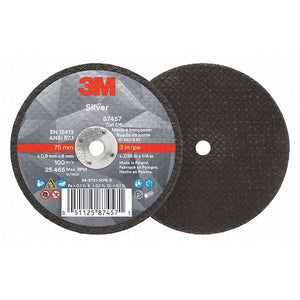
- The 3M 87457 abrasive cut-off wheel is a Type 1 wheel, 3 in diameter, 0.035 in thick, with a 1/4 in arbor, a size made for small die grinders and compact cut-off tools.
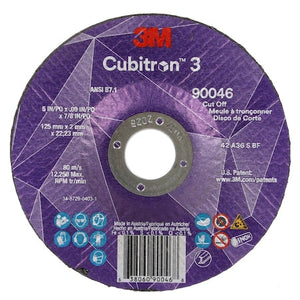
- The 3M Cubitron 90046 cut-off wheel is a Type 27 cut-off wheel, 5 in diameter, 0.09 in thick, with a 7/8 in arbor, rated for cutting. The depressed center keeps the nut below the wheel face on an angle grinder. Some cut-off wheels use a Type 27 shape so the nut clears the work; use them only for the cutting the label rates.
If you cut a lot of bar, conduit or sheet, a thin wheel cuts faster and wastes less material. If the work involves heavy stock or rough handling, a thicker wheel lasts longer in the cut. See the full range in Grinding and Cut-Off Wheels.
Type 27 vs Type 1 grinding wheel: which one do you need?
Buyers often ask about Type 27 vs Type 1 because both fit a lot of tools. The difference is the profile and how you use it.
- Type 1 is flat. It has no raised hub, so the nut and flange stand proud of the face. That is fine for cutting with the edge. It is not made for grinding with the face.
- Type 27 has a raised center. The nut sits inside the depression, so the face can sit flat on the work. That makes it the standard choice for grinding welds, removing rust and deburring on an angle grinder.
If you want to grind a flat surface, buy a Type 27 or a Type 29. If you want to cut, buy a wheel marked for cutting. When in doubt, read the label for the rated operation.
Type 27 vs Type 29, and flap discs
A Type 29 is a Type 27 with a conical face. The angle lets you lean the wheel into corners and blend weld seams with less effort. A Type 27 is flatter, so it works well on flat plate and gives a flat result.
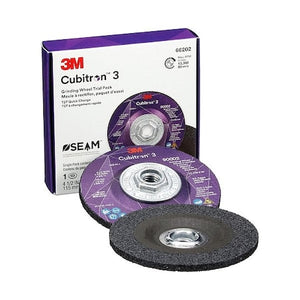
Two Type 27 depressed center grinding wheels we stock, both 4-1/2 in diameter and 0.25 in thick:
- 3M Cubitron 66202 depressed center wheel
- 3M 7100245024 depressed center grinding wheel
Flap disc vs grinding wheel
A flap disc is a stack of abrasive flaps on a backing plate. It grinds and blends in one step, and it leaves a finer finish than a rigid grinding wheel. A grinding wheel removes stock fast and holds its shape. Many shops use both: a Type 27 wheel to knock down a weld, then a flap disc to blend it.
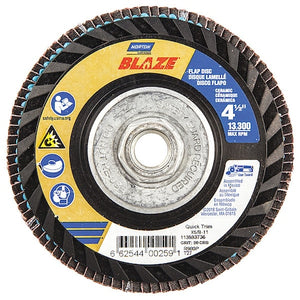
- The Norton 66254400259 flap disc is 4-1/2 in, 80 grit, with a 5/8-11 thread, from the SG Blaze line.
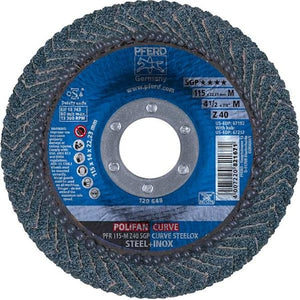
- The Pferd 67192 POLIFAN flap disc uses zirconia grain and is 4-1/2 in by 7/8 in.
See the wider Abrasives category.
Bench grinding wheel types and wire wheels
A bench grinder takes a different wheel: a bonded wheel, often vitrified, that sits between flanges on a stationary machine. It is used for sharpening tools, shaping metal and cleaning up edges.
- The Pferd 61770 vitrified bench wheel is 10 x 1 x 2 in, 46 grit, aluminum oxide.
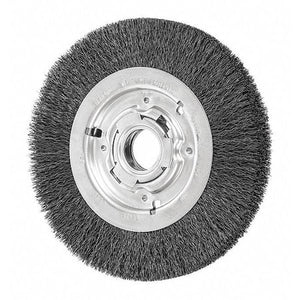
A wire wheel does not cut metal away. It cleans: rust, paint, scale and weld discoloration. Choose crimped wire for general cleaning and read the label for the tool and speed it is rated for.
- The Pferd 81127 crimped wire wheel is 8 in in diameter.
Related stock lives in Wire Brushes and Abrasive Accessories and Stones.
Abrasive grains: which one for which metal
The grain is the part that actually cuts. These are the four you will see on wheel labels.
| Grain | Typical use |
|---|---|
| Aluminum oxide | General-purpose grain for steel and other ferrous metals |
| Zirconia alumina | Faster cutting on steel and stainless |
| Ceramic | Premium grain for tough alloys and heavy stock removal |
| Silicon carbide | Cast iron, non-ferrous metals, stone and other non-metals |
Read the wheel label for the metals it is rated for before you use one on stainless or non-ferrous work.
Grit basics: coarse to fine
Grit is the size of the abrasive particles. The lower the number, the coarser the grit.
Makers group grits differently, so treat these as rough bands for flap discs and depressed center wheels:
- Coarse (about 24 to 40): fast stock removal, rough weld grinding.
- Medium (about 50 to 80): general grinding and blending. An 80 grit flap disc is a common middle choice.
- Fine (100 and up): finish work and light blending.
Coarse grit removes more metal but leaves deeper scratches. A fine grit leaves a better finish but cuts slowly. Start coarse for stock removal, then step finer for the surface you need.
How to match a wheel to your tool
Before you buy, check four things against the tool, not the wheel you already own.
- Diameter and thickness. The wheel must fit the tool and sit inside the guard. A 4-1/2 in wheel goes on a 4-1/2 in grinder, and a thicker wheel may not clear the guard.
- Arbor size. The center hole or thread must match the spindle. Common sizes on angle grinders are a 7/8 in arbor hole and a 5/8-11 thread, and a small die grinder wheel may use a 1/4 in arbor. Always match your tool.
- Maximum RPM. OSHA 1910.215 requires the machine spindle speed to be checked against the maximum operating speed marked on the wheel, so the wheel's maximum RPM must be at or above the tool's RPM.
- Rated use. Read the label for the operation the wheel is rated for: cutting, grinding, face or edge, and the materials it suits.
Safety basics for abrasive wheels
OSHA covers abrasive wheel machinery in 29 CFR 1910.215 (the same text is on Cornell LII), and the industry also refers to ANSI B7.1.
- Use the guard. Abrasive wheels are to be used on machines with safety guards, with limited exceptions listed in the rule.
- Inspect and ring test. Immediately before mounting, inspect every wheel for damage and sound it with the ring test: tap it gently with a light nonmetallic tool, such as a screwdriver handle for light wheels or a wooden mallet for heavier ones, and listen for a clear ring. A dead sound means the wheel may be cracked, so do not use it. The wheel must be dry and free of sawdust for the test.
- Check the speed. Confirm the tool's spindle speed does not exceed the maximum marked on the wheel.
- Set the work rest. On bench grinders, keep the work rest close to the wheel. The rule gives a maximum opening of one-eighth inch.
- Protect your eyes and face. Wear impact-rated eyewear and add a face shield for grinding and cutting, plus a dust mask or respirator where grinding dust is present (see our N95 respirator guide). See our ANSI Z87.1 vs Z87+ guide. Shop Safety Glasses and Face Shields.
Common mistakes
- Using a cut-off wheel to grind with its side.
- Mounting a wheel whose maximum RPM is below the tool speed.
Standardize and reorder
Pick one wheel per job and write the part number on the shelf bin: one cut-off wheel, one Type 27 grinding wheel, one flap disc and one wire wheel. Reordering by part number is faster than searching, so use Quick Order. Orders of $79 or more ship free. Orders placed by 2 PM ET on a business day ship in 1-2 business days.
Our picks
- Cutting, small tools: 3M 87457 (MPN 87457), Type 1, 3 in, 0.035 in, 1/4 in arbor.
- Cutting on an angle grinder: 3M Cubitron 90046 (MPN 90046), Type 27, 5 in, 0.09 in, 7/8 in arbor.
- Grinding welds and surfaces: 3M Cubitron 66202 (MPN 66202) and 3M 7100245024 (MPN 7100245024), Type 27, 4-1/2 in, 0.25 in.
- Grinding and blending: Norton 66254400259 (MPN 66254400259), 80 grit, 5/8-11; and Pferd 67192 (MPN 67192), zirconia, 4-1/2 in x 7/8 in.
- Bench grinder: Pferd 61770 (MPN 61770), 10 x 1 x 2 in, 46 grit, aluminum oxide.
- Cleaning: Pferd 81127 (MPN 81127), 8 in crimped wire wheel.
Browse every wheel in Grinding and Cut-Off Wheels.
Shop the products in this guide
-
3M
Abrasive Cut-Off Wheel, Type 1, 3 in Dia, 0.035 in Thick, 1/4 in Arbor Hole Size
MPN 87457
- MPN: 87457
$4.14
Ships in 1-2 business days
In stock
-
3M Cubitron
Cut-Off Wheel, Type 27, 5 in Dia, 0.09 in Thick, 7/8 in Arbor Hole Size
MPN 90046
- MPN: 90046
$16.76
Ships in 1-2 business days
In stock
-
$28.98
Ships in 1-2 business days
In stock
-
3M
Depressed Center Grinding Wheel, Type 27, 4 1/2 in Dia, 0.25 in Thick
MPN 7100245024
- MPN: 7100245024
$12.56
Ships in 1-2 business days
In stock
-
Norton Abrasives
Flap Disc, 4 1/2 in x 80 Grit, 5/8-11, Series: SG Blaze
MPN 66254400259
- MPN: 66254400259
$17.23
Ships in 1-2 business days
In stock
-
Pferd Tools
4-1/2" x 7/8" A.H. POLIFAN Flap Disc - Z SGP CURVE STEELOX, Zirconia
MPN 67192
- MPN: 67192
$22.35
Ships in 1-2 business days
In stock
-

Pferd Tools
Vitrified Bench Wheel, UNIVERSAL, 10" x 1 x 2, 46 Grit, Aluminum Oxide
MPN 61770
- MPN: 61770
$84.23
Ships in 1-2 business days
In stock
-
$95.39
Ships in 1-2 business days
In stock

Frequently asked questions
What is the difference between a Type 1 and a Type 27 grinding wheel?
A Type 1 wheel is flat and straight, with no bend, and is used on its edge or face as the maker rates it, often for cutting. A Type 27 has a raised hub, called a depressed center, so the nut sits below the wheel face and you can grind flat surfaces with the face. Check the wheel label for its rated use.
What is the difference between a cut off wheel and a grinding wheel?
A cut off wheel is thin and made for cutting through stock with its edge. A grinding wheel is thicker and made to remove material, usually with the face or edge. Thin cut off wheels are not built for side loads, so do not use one to grind across its flat face unless the label allows it.
Is a flap disc better than a grinding wheel?
Neither is better for every job. A grinding wheel removes material quickly and holds its shape, while a flap disc grinds and blends in one step and leaves a finer finish. Many shops use a grinding wheel for heavy stock removal and a flap disc for weld blending and finish work. Match the product to the task.
What are the four common abrasive grains in grinding wheels?
Aluminum oxide is the general-purpose grain for steel and other ferrous metals. Zirconia alumina cuts faster on steel and stainless. Ceramic grain is a premium option for tougher alloys and heavy stock removal. Silicon carbide suits cast iron, non-ferrous metals, stone and other non-metal work. Read the wheel label for the rated materials.
How do I know a grinding wheel fits my grinder?
Check three things. The wheel diameter and thickness must fit the tool and its guard, the arbor hole must match the spindle or threaded hub, and the maximum RPM marked on the wheel must be at or above the speed on the tool nameplate. If any one does not match, do not mount the wheel.
Guide
Socket Set Sizes: SAE and Metric Chart
Socket set sizes in SAE and metric, with mm equivalents, drive sizes and 6-point vs 12-point.
Safety
Cut-Resistant Glove Levels: ANSI A1 to A9 Explained
Cut resistant gloves levels A1 to A9 explained: match the level to your task, read the ratings, compare...
Safety
Nitrile vs Latex vs Vinyl Gloves: Which to Choose
Nitrile vs latex vs vinyl gloves compared on allergy risk, puncture and chemical resistance, fit, cost and best uses.
New guides and deals by email
Buying guides, new products and deals for US businesses.