

Nitrile vs Latex vs Vinyl Gloves: Which to Choose
Nitrile vs latex vs vinyl gloves compared on allergy risk, puncture and chemical resistance, fit, cost and best uses. Pick the right disposable glove.

In this guide
- Nitrile vs latex gloves vs vinyl: how the three materials differ
- Comparison chart: protection
- Comparison chart: fit, cost and best uses
- Latex vs vinyl gloves: when each still makes sense
- Food-safe vs exam vs industrial grades
- Thickness (mil), powder-free and other specs that matter
- Common mistakes when choosing disposable gloves
- How to standardize and reorder gloves
- Our picks: nitrile, latex and vinyl gloves from the store
- Shop the products in this guide
Quick answer: In the nitrile vs latex gloves choice, nitrile is the default disposable glove for most facilities: latex-free, tough against punctures, and good with oils and many cleaning chemicals. Choose latex when you need the closest fit and stretch and latex allergy is not a concern. Choose vinyl for short, low-risk tasks where gloves change every few minutes and cost per glove matters most.
Nitrile vs latex vs vinyl gloves is a decision about three things: who touches the glove, what the glove touches, and how long it stays on. This guide is for facility managers, janitorial and maintenance crews, kitchen managers and purchasing agents who order disposable gloves by the box or the case. If you only need the short version of nitrile vs latex gloves, the quick answer above covers it. The rest explains the trade-offs so you can write one standard and stop second-guessing the order. Every product named below is in our Disposable Gloves collection or a related one, and each spec comes from the product listing.
Shop the 8 products in this guide
Nitrile vs latex gloves vs vinyl: how the three materials differ
All three are single-use glove materials, but they come from different sources and behave differently on the hand.
- Nitrile is a synthetic rubber. It contains no natural rubber latex, so it is the standard choice where latex exposure has to be avoided.
- Latex is natural rubber. It is soft, stretchy and conforms to the hand, but it contains natural rubber latex proteins that cause an allergic reaction in some people.
- Vinyl is a PVC plastic. It is loose-fitting, inexpensive and also latex-free, but it stretches little and wears through faster under stress.
The FDA notes that some people are allergic to natural rubber latex and that manufacturers must identify the materials on medical glove labeling. It lists synthetic materials such as PVC, nitrile and polyurethane as alternatives. We are not giving medical advice here. If a person on your team has a known or suspected glove reaction, they should check with a medical professional, and you should read the material line on every product label before you standardize.
Comparison chart: protection
Use this table first, since protection decides which materials are even on the shortlist. These are general characteristics. Thickness, formulation and brand change the real numbers, so check the maker's own chemical resistance data for any specific chemical.
| Factor | Nitrile | Latex | Vinyl |
|---|---|---|---|
| Latex allergy risk | None from latex protein | Highest of the three | None from latex protein |
| Puncture and tear resistance | Good | Good, stretches before it tears | Lowest of the three |
| Oils, grease, solvents | Generally best | Weak with oils | Limited |
| Water-based cleaners | Good | Good | Good for brief contact |
Comparison chart: fit, cost and best uses
| Factor | Nitrile | Latex | Vinyl |
|---|---|---|---|
| Fit and feel | Close fit, firm | Closest fit, most stretch | Loose, little stretch |
| Cost per glove | Mid to high | Mid | Lowest |
| Best uses | Cleaning, maintenance, auto, general food prep | Detail work, tasks needing fingertip feel | Quick food handling, light dusting, short tasks |
A table cannot capture every job. Nitrile vs latex gloves for cleaning usually lands on nitrile, because cleaning chemicals, degreasers and grease are where latex falls short. Nitrile vs vinyl gloves for cleaning is a closer call. Vinyl is fine for wiping surfaces with mild products and changing gloves often. Nitrile is the better pick once the task involves oil, scrubbing against rough surfaces or longer wear.
Latex vs vinyl gloves: when each still makes sense
Most buyers have already narrowed to nitrile or one other material, so here is the head-to-head. Latex vs vinyl gloves is mainly a fit and durability question. Latex gives a snug, sensitive fit and does not tear easily during stretching work. Vinyl is cheaper and has no latex protein, but it is loose and can split at the seams on tasks that load the glove.
Latex makes sense for controlled settings where allergy is not a concern and fingertip feel matters. Vinyl makes sense for high-change tasks such as sandwich assembly, light janitorial wipe-downs and anything where gloves are discarded every few minutes. See our nitrile glove guide for facilities for a facility-level standard.
Food-safe vs exam vs industrial grades
The word "grade" is not one regulated scale, so read the label rather than the marketing line.
- Exam gloves are regulated by the FDA as medical devices. The FDA states that medical gloves, including examination gloves, are Class I reserved devices that need a 510(k) premarket notification. The product label or listing should say it is an exam or medical glove. We do not repeat part numbers or clearances here, because the only reliable source is the label on the glove you are buying.
- Food-handling gloves are sold for contact with food. Materials that touch food are covered in general by the FDA indirect food additive rules in 21 CFR Part 177, which cover polymers used in food-contact articles. That is a general pointer, not a claim about any one product. Check the listing for a food-contact statement.
- Industrial or general-purpose gloves are made for cleaning, maintenance and shop use. They may not carry a medical or food-contact claim, and they are often thicker.
Your use decides the grade. A kitchen needs a food-contact glove. A clinic needs an exam glove. A maintenance crew needs a durable industrial glove. One glove can satisfy more than one use, but only the label can tell you.
Thickness (mil), powder-free and other specs that matter
Thickness in mil
Disposable glove thickness is measured in mil. 1 mil = 0.001 in = 0.0254 mm. A 5 mil glove is 0.005 in, about 0.127 mm. More mil generally means more puncture and chemical resistance and less feel. Only compare mil within one material, because 3 mil of vinyl does not behave like 3 mil of nitrile.
The listings show these thicknesses:
- North Dexi-Task LA049PF/M: 5 mil nitrile, powder-free
- Ansell V29: 2.8 mil vinyl, powder-free
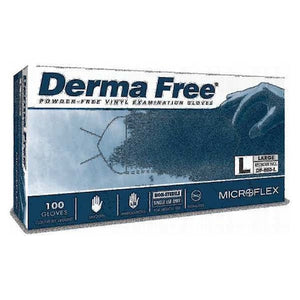
- Ansell Microflex Derma Free DF-850-M: vinyl, powder-free
Powder-free
Powder-free gloves skip the donning powder. Most facility buyers specify powder-free by default so powder does not reach food, surfaces or finished work. The FDA banned powdered surgeon's and patient examination gloves in a 2016 final rule, which is another reason powder-free is the standard in healthcare supply. For your own site, powder-free is a one-line spec to write into the purchasing standard.
Size
Disposable gloves are sold in letter sizes from small to extra large. Fit matters because a glove that is too small tears at the cuff and one that is too large snags and loses feel. For hand measurements and size conversions, see our work glove size chart, which also notes that disposable gloves size by palm width.
Box and case counts
A box of 100 is common, and 10 boxes per case is common, which makes 1,000 gloves per case. Some gloves come 50 to a box. Counts vary by product, so check the listing before you compare prices. Always divide the price by the glove count to get cost per glove.
Common mistakes when choosing disposable gloves
Buying on box price. A 50-count box looks cheaper than a 100-count box until you divide.
Using vinyl for jobs that stress the glove. Vinyl is built for short, light tasks. Heavy wiping against rough surfaces, oils and long wear split it.
Assuming thicker is always better. More mil costs more and reduces feel. A food line may not need a 5 mil glove.
Ignoring the allergy question. A single latex product in a shared closet can reach a person who reacts to it. If latex is not required, many sites remove it.
Skipping the label. Exam, food-contact and general-purpose are different claims. Read the listing.
How to standardize and reorder gloves
- Pick one material per task. For example, nitrile for cleaning and maintenance, vinyl for short food assembly tasks.
- Write the spec. Material, thickness in mil, powder-free yes or no, size range and pack count.
- Stock three sizes. Stock the sizes your crew actually wears; many sites start with medium, large and extra large.
- Reorder by part number. Paste your SKU list and quantities into Quick Order each cycle.
Orders of $79 or more ship free. Orders placed by 2 PM ET on a business day ship in 1-2 business days.
Our picks: nitrile, latex and vinyl gloves from the store
Specs below come from each product listing. Check the listing for the full details on any glove before ordering a case.
| Product | Material | Size and count | Notes |
|---|---|---|---|
| Emerald 5802 | Nitrile | Large, 100 ct | General cleaning and food handling |
| Kimtech 62762 | Nitrile | Medium, 50 ct | Lab, clinic and color-coded zones |
| North Dexi-Task LA049PF/M | Nitrile, 5 mil | Medium, 100 pk | Powder-free, heavier duty |
| Ansell V29 | Vinyl, 2.8 mil | Medium, 100 pk | Powder-free, short tasks |
| Ansell Microflex Derma Free DF-850-M | Vinyl | Medium | Powder-free |
| Bnaddain MF-300-XL | Latex, white | Extra large, 100 ct | Latex option |
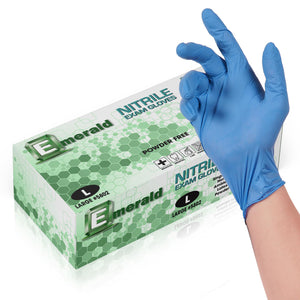
- Nitrile, everyday: Emerald 5802 (MPN 5802). A nitrile glove in Large, 100 count. A sensible default for a janitorial cart where you want one standard box size.
- Nitrile, heavier duty: North Dexi-Task LA049PF/M (MPN LA049PF/M). A 5 mil, powder-free nitrile glove, 100 per pack, in Medium. The listed thickness is easy to write into a maintenance or shop standard.
- Nitrile, lab and clinic: Kimtech 62762 (MPN 62762). A nitrile glove in Medium, 50 count. A smaller box suits low-volume stations and trial orders.
- Vinyl, budget and short tasks: Ansell V29 (MPN V29). A 2.8 mil powder-free vinyl glove, 100 per pack, in Medium. For tasks where gloves change every few minutes.
- Vinyl, a step up: Ansell Microflex Derma Free DF-850-M (MPN DF-850-M). A powder-free vinyl glove in Medium.
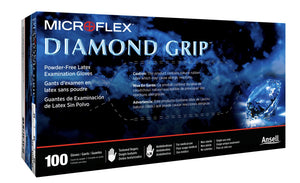
- Latex: Bnaddain MF-300-XL (MPN MF-300-XL). A white latex glove in Extra Large, 100 count, for sites that have decided latex is acceptable.
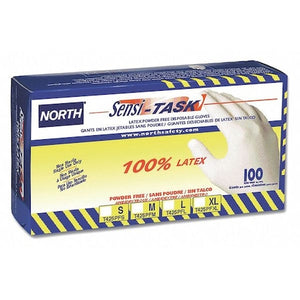
Two more listings fit the same shopping list: the Mechanix Wear D04-00-010-100, listed in Large, 100 count, and the North Sensi-Task T425PF/S, a powder-free natural rubber latex glove with a 5 mil palm, in Small. Check each product page for material, thickness and intended use before you add either to a standard.
Browse the full range in Disposable Gloves, or go straight to Nitrile Gloves, Latex Gloves or the wider Gloves department. For gloves meant for repeated wear, see Work Gloves.
Sources
- FDA: Medical Gloves (materials labeling, latex allergy note, examination gloves as medical devices, powdered glove ban)
- 21 CFR Part 177, Indirect Food Additives: Polymers
Shop the products in this guide
-
 Pack of 100
Emerald
Protective Glove 5802, Large, 100 Count
MPN 5802
- MPN: 5802
- Pack of 100
- Size: Large
- Material: Nitrile
$28.03
$0.28 / gloveShips in 1-2 business days
In stock
-
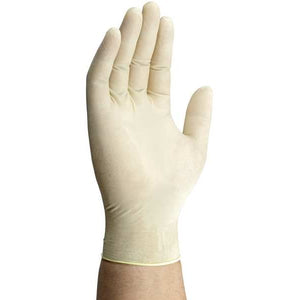 Pack of 100
Mechanix Wear
Protective Glove D04-00-010-100, Large, 100 Count
MPN D04-00-010-100
- MPN: D04-00-010-100
- Pack of 100
- Size: Large
- Material: Latex
$47.58
$0.48 / gloveShips in 1-2 business days
In stock
-
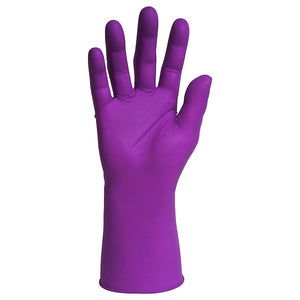 Pack of 50
Kimtech
Protective Glove 62762, Medium, 50 Count
MPN 62762
- MPN: 62762
- Pack of 50
- Size: Medium
- Material: Nitrile
$64.24
Ships in 1-2 business days
In stock
-
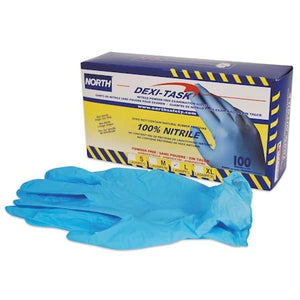 Pack of 100
North
Dexi-Task, Disposable Gloves, 5 mil Palm, Nitrile, Powder-Free, 8, Pack of 100, Blue
MPN LA049PF/M
- MPN: LA049PF/M
- Pack of 100
$15.33
Ships in 1-2 business days
In stock
-
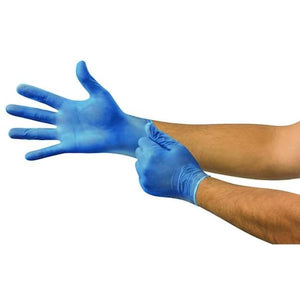
Ansell
Disposable Gloves, 2.8 mil Palm, Vinyl, Powder-Free, M (8), Pack of 100, Blue
MPN V29
- MPN: V29
$11.18
Ships in 1-2 business days
In stock
-
 Pack of 100
Ansell
Microflex Derma Free Disposable Gloves, Vinyl, 3.9 mil Palm, Powder-Free, M, Pack of 100, Clear
MPN DF-850-M
- MPN: DF-850-M
- Pack of 100
$14.23
Ships in 1-2 business days
In stock
-
 Pack of 100
North
Sensi-Task, Disposable Gloves, 5 mil Palm, Natural Rubber Latex, Powder-Free, S, Pack of 100, White
MPN T425PF/S
- MPN: T425PF/S
- Pack of 100
$24.95
Ships in 1-2 business days
In stock
-
 Pack of 100
Bnaddain
Latex Glove, 100 Count, White
MPN MF-300-XL
- MPN: MF-300-XL
- Pack of 100
- Size: 100 Count
- Color: White
$35.46
Ships in 1-2 business days
In stock
Frequently asked questions
Which is better, nitrile or latex gloves?
Neither wins every job. Nitrile is latex-free and generally holds up better against oils, solvents and punctures, so it is the usual default for cleaning, maintenance and shops. Latex stretches more and gives a close, sensitive fit for detail work, but it carries a latex allergy concern. Choose by task, and check the product listing for the material.
Are nitrile or vinyl gloves better for food handling?
Both are sold for food handling, and the right check is the product label or listing, which should say the glove is intended for food contact. Vinyl is a low-cost choice for short tasks with frequent changes. Nitrile fits closer and resists tears better, which suits longer prep. Confirm food-contact suitability before you buy a case.
Are nitrile gloves more expensive than latex or vinyl?
Nitrile usually costs more per glove than vinyl and is often priced near or above latex, though prices move with thickness and pack size. Compare cost per glove, not box price: divide the listed price by the count on the product page. A thicker glove costs more per glove but may replace two thinner ones.
Do nitrile gloves cause allergic reactions like latex?
Nitrile is made without natural rubber latex, so it avoids the latex protein that causes latex allergy. Some people still react to other glove ingredients. If anyone on your staff has had a glove reaction, ask them to check with a medical professional and read the ingredient and material details on the product label before you standardize.
What does mil mean on gloves?
A mil is one thousandth of an inch, so 1 mil equals 0.001 in, or 0.0254 mm. A 5 mil glove is 0.005 in thick. Higher mil generally means more puncture and chemical resistance but less fingertip feel. Compare mil only between gloves of the same material, since a 3 mil nitrile and a 3 mil vinyl behave differently.
Can I use exam gloves for cleaning and industrial work?
Yes, many facilities do, but the grades differ. Exam gloves are regulated as medical devices and are labeled as such. Food-handling gloves are sold for food contact, and industrial gloves are sold for general work. Read the label for the intended use, and pick a thicker or reusable glove when the task involves chemicals or sharp edges.
Safety
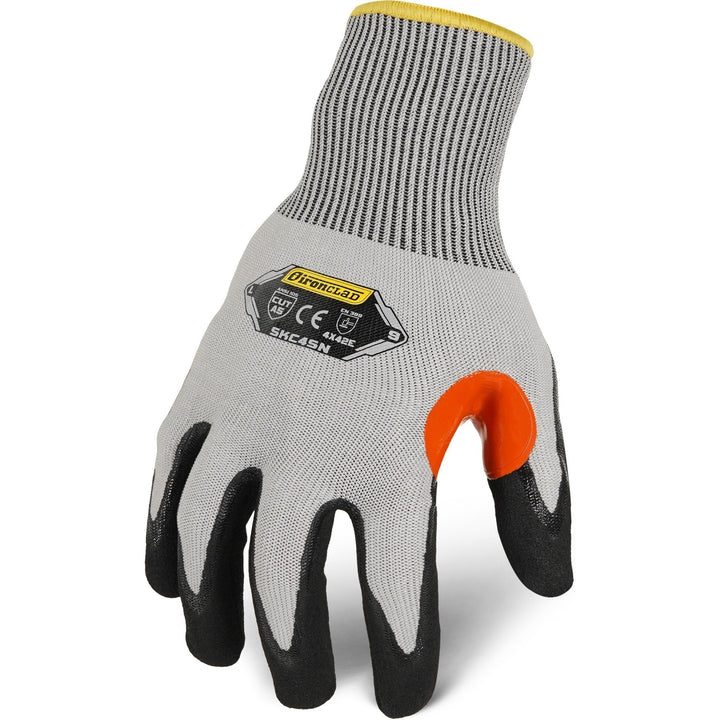
Cut-Resistant Glove Levels: ANSI A1 to A9 Explained
Cut resistant gloves levels A1 to A9 explained: match the level to your task, read the ratings, compare...

Safety & PPE
Work Glove Size Chart: How to Measure Your Hand (Numeric, S-XXL and EU Sizes)
Find your work glove size in 60 seconds.
Safety & PPE
ANSI Cut Level Chart: A1-A9 Cut-Resistant Gloves Explained
ANSI/ISEA 105 cut levels A1-A9 in one chart: grams per level, example jobs, old 1-5 and EN 388...
New guides and deals by email
Buying guides, new products and deals for US businesses.