Quick answer: ANSI/ISEA 105 rates glove cut resistance from A1 (200-499 grams of blade load) to A9 (6,000 grams or more), measured on a TDM-100 straight-blade test. A1-A3 covers packaging and light assembly, A4-A6 covers construction, HVAC sheet metal and glass handling, and A7-A9 covers sharp metal, recycling and blade-contact work. OSHA 1910.138 requires hand protection that matches the hazard; the chart shows which level that usually means.
Last updated: October 17, 2026
This ANSI cut level chart is for safety managers, maintenance crews, contractors and purchasing agents who need to pick a cut level, write it into a PPE standard and reorder by part number. Every product mentioned is listed in our Cut & Chemical Resistant Gloves or Gloves collection, with specs taken from the product page.
In this guide
ANSI cut level chart (A1-A9) with grams and example jobs
ANSI/ISEA 105 is the US standard for classifying hand protection. The cut section assigns one of nine levels based on the weight, in grams, that a straight blade needs to cut through the glove material over a 20 mm stroke. Higher grams, higher level.
| ANSI level |
Grams of cutting load |
Typical hazard |
Example jobs |
| A1 |
200-499 g |
Nuisance cuts |
Light packaging, small parts, material handling with few edges |
| A2 |
500-999 g |
Light cuts |
Warehouse picking, box cutters, general assembly |
| A3 |
1,000-1,499 g |
Light to moderate cuts |
Parts handling, light sheet material, maintenance with occasional sharp edges |
| A4 |
1,500-2,199 g |
Moderate cuts |
Construction, HVAC ductwork, sheet metal, automotive and fleet work |
| A5 |
2,200-2,999 g |
Moderate to heavy cuts |
Glass handling, metal stamping, wire stripping, heavier sheet metal |
| A6 |
3,000-3,999 g |
Heavy cuts |
Metal fabrication, glazing, demolition, recycling sorting |
| A7 |
4,000-4,999 g |
Heavy cuts, sharp stock |
Sharp metal edges, blade changes, steel coil handling |
| A8 |
5,000-5,999 g |
Extreme cuts |
Food processing with knives, glass plants, blade contact |
| A9 |
6,000 g and up |
Extreme cuts |
Direct blade contact, sharp metal and glass, recycling of sharp scrap |
The bands come from ANSI/ISEA 105 and the ASTM F2992 test method as published by the International Safety Equipment Association (ISEA). The example jobs are a starting point, not a rule; the level you need is set by your hazard assessment, covered under OSHA below.
The nine levels group into three tiers: A1-A3 light duty (thin 13 to 18 gauge knits where dexterity matters most), A4-A6 medium to heavy duty (the working range for most trades, using HPPE, aramid, glass or steel composite yarns), and A7-A9 extreme duty (heavier reinforced liners for expected blade or sharp-edge contact).
How the cut test works (ASTM F2992, TDM-100)
Since the 2016 revision, ANSI/ISEA 105 uses one cut test: ASTM F2992 on a TDM-100 tomodynamometer. A straight razor blade is drawn across a glove sample under a set load, with a fresh blade each run, and the result is the load in grams that produces cut-through at 20 mm of blade travel.
Grams of cutting load
A glove rated A4 needed 1,500 to 2,199 grams on the blade to cut through at 20 mm. Because each level is a range, two A4 gloves can differ by several hundred grams; the actual test value is sometimes on the manufacturer data sheet if you need to split hairs between models.
What the cut level does not measure
The rating covers a straight blade moving across the material and nothing else:
-
Puncture. ANSI/ISEA 105 has a separate puncture scale (levels 0-5) for a standard probe, and a separate needle-stick (hypodermic needle) test.
-
Abrasion. A separate abrasion scale (levels 0-6) covers wear from rough surfaces.
-
Impact. Back-of-hand impact protection is tested under ANSI/ISEA 138, not 105. Impact gloves such as the Ringers Gloves 162 (impact-resistant, orange depending on size) are specified for knuckle and finger protection; check the listing for a cut level before relying on them for cut work.
-
Powered or serrated blades. No glove rating covers saw blades or grinders.
-
Coverage. A glove with a cut-resistant palm and a plain knit back protects only where the rated material is.
Old ANSI cut level 1-5 vs A1-A9 conversion
Before 2016, ANSI/ISEA 105 (the 2005 and 2011 editions) used five levels based on ASTM F1790, and older spec sheets and packaging still show "cut level 4" or "level 5". The scales do not line up one to one.
| Old ANSI level (105-2005/2011) |
Grams (ASTM F1790) |
Approximate new level (105-2016 and later) |
| 1 |
200 g and up |
A1 |
| 2 |
500 g and up |
A2 |
| 3 |
1,000 g and up |
A3 |
| 4 |
1,500-3,499 g |
A4, A5 or A6 |
| 5 |
3,500 g and up |
A6 and above |
The old level 4 band was very wide, which is the main reason the standard was rewritten. If your PPE program still says "ANSI cut level 4", decide whether you meant the bottom of that band (now A4) or the top (now A6) and rewrite the spec with the new code.
ANSI A1-A9 vs EN 388 cut levels: the crosswalk
Gloves sold in both the US and Europe often carry an EN 388 shield next to the ANSI mark. EN 388:2016 reports two cut results: the coup test (levels 1-5, a rotating circular blade; reported as "X" when the blade dulls on high-performance yarn) and the ISO 13997 TDM test (letters A-F), the same type of straight-blade test as ASTM F2992 but reported in newtons.
| EN 388 ISO 13997 letter |
Minimum force (newtons) |
Approximate grams |
Nearest ANSI level |
| A |
2 N |
about 204 g |
A1 |
| B |
5 N |
about 510 g |
A2 |
| C |
10 N |
about 1,020 g |
A3 |
| D |
15 N |
about 1,530 g |
A4 |
| E |
22 N |
about 2,240 g |
A5 |
| F |
30 N |
about 3,060 g |
A6 and above |
Conversion uses 1 N equal to roughly 102 grams-force. Treat the crosswalk as approximate: sample preparation and reporting rules differ, so a glove that tests D in Europe may test A4 or A5 in the US. EN 388 marking is mandatory in the EU; ANSI/ISEA 105 marking is voluntary in the US.
Reading an EN 388 shield (example: 4X42C)
The code reads abrasion (1-4), coup cut (1-5 or X), tear (1-4), puncture (1-4), then the ISO 13997 letter (A-F) and an optional impact "P". So 4X42C is abrasion 4, coup cut not applicable, tear 4, puncture 2, TDM cut level C. The letter is what you compare against the ANSI chart.
Which cut level do you need? Cut resistant glove levels by job
Match the level to the sharpest edge a worker will contact, then confirm with a trial on the floor. The table groups common jobs by the level most buyers specify.
| Work environment |
Typical level |
Why |
| Warehouse picking, packing, box cutters |
A2-A3 |
Low cut load, high need for dexterity and grip |
| General maintenance, facilities, light assembly |
A3-A4 |
Occasional sharp edges, tools in hand all day |
| HVAC, ductwork, sheet metal, construction |
A4-A5 |
Continuous contact with cut edges and screws |
| Automotive and fleet shops |
A4 |
Trim, brackets, body panels and brake work |
| Glass handling, glazing, metal stamping |
A5-A6 |
Heavier, sharper edges and heavier stock |
| Metal fabrication, demolition, recycling |
A6-A7 |
Sharp scrap, unpredictable edges |
| Food processing with knives, blade changes, sharp metal |
A8-A9 |
Direct blade contact |
Warehouse and box cutters (A2-A3)
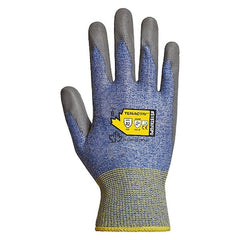
Picking, packing and opening cases with a utility knife rarely needs more than A2 or A3. A thick, hot glove gets taken off, and a lighter glove that stays on the hand protects better than a heavier one in a pocket. The Superior Glove S15TAFGPU-9 (knit, dipped, listed at ANSI cut level A3) is a reasonable default for this tier.
HVAC, sheet metal, construction and auto (A4-A6)
What cut level gloves for sheet metal is one of the most common questions we get. A4 is the usual floor for ductwork, framing, roofing and body shops because it balances protection against the dexterity needed to drive screws and handle fasteners; heavier gauge stock, glass or stamped parts push buyers to A5 or A6. The Superior Glove S18TAFGPU family (knit, dipped palm, ANSI cut level A4, sizes 5-12) is our main A4 pick.
Glass, stamping and recycling (A7-A9)
For sharp scrap, blade changes or direct knife work, go to the top tier and expect a heavier liner with less fingertip feel. Most sites issue A7-A9 gloves only to workers on those tasks. Browse current A5 and higher options in Cut & Chemical Resistant Gloves.
A6 vs A4 cut level: why the highest level is not the best default
Over-speccing has a cost. A6-A9 gloves are thicker, warmer and more expensive, and dexterity drops as liners get heavier; a glove removed for fine work protects nothing. The right level is the lowest one that covers the assessed hazard, which is why A4 is the most common company-wide minimum with higher levels issued by task.
What OSHA 1910.138 requires
Three OSHA provisions apply to cut-resistant gloves:
-
29 CFR 1910.138(a) requires employers to select and require employees to use appropriate hand protection when hands are exposed to hazards such as skin absorption of harmful substances, severe cuts or lacerations, severe abrasions, punctures, chemical burns, thermal burns and harmful temperature extremes.
-
29 CFR 1910.138(b) requires that selection be based on an evaluation of the performance characteristics of the hand protection relative to the task, conditions present, duration of use and the hazards and potential hazards identified.
-
29 CFR 1910.132(d) requires a hazard assessment of the workplace to determine which PPE is needed, with a written certification that the assessment was done.
OSHA does not specify an ANSI cut level. ANSI/ISEA 105 is a voluntary consensus standard, but it is how nearly every employer shows that the glove selected under 1910.138(b) matches the hazard found under 1910.132(d). Workflow: assess the task, record the sharpest edge and exposure, pick a level, trial it, then write the level and part number into the PPE program.
Coated vs uncoated cut-resistant gloves
Most cut-resistant gloves in the A2-A6 range are a knit liner with a palm coating. The liner yarn sets the cut level. The coating sets grip, durability and liquid resistance. Changing the coating does not change the ANSI level.
Coating types
-
Polyurethane (PU). Thin, good tactile feel, dry and light-oil grip; common on A2-A4 assembly and construction gloves.
-
Foam nitrile. Better grip in light oil, breathable; common in fleet and maintenance.
-
Sandy or microfoam nitrile. Rougher texture for oily or wet parts.
-
Latex crinkle. Strong dry grip for construction and masonry; avoid where latex allergy is a concern.
-
Uncoated. Knit-only, for food processing or as a liner under a leather or chemical glove.
Our product listings show the coating as "Dipped" in the spec table where the manufacturer states it, as on the S18TAFGPU and S15TAFGPU. If your task needs splash or chemical barrier rather than cut protection, see our guide to choosing nitrile gloves for a facility.
Leather and mechanics-style cut-resistant gloves
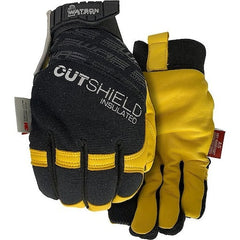
Not every cut-resistant glove is a knit. The Watson Gloves 9005CR cut-resistant mechanics glove (goatskin palm, black, sizes S, M and L) pairs a leather palm with a mechanics-style back. Our listing does not state an ANSI level, so check the manufacturer marking before writing it into a spec that calls for one.
Liner materials
HPPE (high-performance polyethylene) is the light, cool base of most A2-A5 knits; aramid adds heat resistance for A3-A5 and hot work; glass and steel composite yarns wrapped into either are how gloves reach A5-A9.
Sizing cut-resistant gloves
Knit cut-resistant gloves fit close and run roughly true to size, so measure rather than guess: wrap a tape around the dominant hand just below the knuckles, excluding the thumb, and round the inch reading up for the numeric size on most US industrial charts (7 = S, 8 = M, 9 = L, 10 = XL). Brand scales differ; Superior Glove runs sizes 5 through 12, and the S18TAFGPU is stocked in every size in that range. Order at least three sizes for a mixed crew, each as its own line. Full charts for Superior, Watson, Ansell/Ringers and Mechanix, plus the EN 420 sizes, are in our work glove size chart.
Washing, inspecting and replacing cut-resistant gloves
Laundering instructions are manufacturer specific; many knit gloves can be machine washed cool, but bleach, high heat and solvents can damage coatings and some yarns. Follow the product data sheet. Inspect before each shift and retire the glove when:
- The liner is worn through or fuzzed at the fingertips or palm.
- The coating is peeling, cracked or has lost grip.
- The cuff has stretched so the glove slides on the hand.
- The glove has been cut; a cut in the liner is a cut in the protection.
A worn liner does not keep its original level. Track pairs per worker per month and set a replacement interval rather than waiting for failure.
What changed in ANSI/ISEA 105-2024
The current edition is ANSI/ISEA 105-2024. The cut bands did not change: A1-A9 and the gram ranges above are the same as in 2016. What changed is a new pentagon-style pictogram showing abrasion, cut and puncture results together, a reference to ANSI/ISEA 125-2021 for conformity assessment, and updated test method references. A data sheet that still cites 105-2016 reports a cut level that is still valid and comparable.
Cut-resistant gloves we stock by level
| Product |
Listed cut level |
Key spec |
Price |
Best for |
| Superior Glove S15TAFGPU-9 |
A3 |
Knit, dipped, pair |
|
Warehouse, maintenance, light assembly |
| Superior Glove S18TAFGPU-9 |
A4 |
Knit, dipped, pair, sizes 5-12 |
|
HVAC, sheet metal, construction, fleet |
| Watson Gloves 9005CR-L |
Not stated on listing |
Cut-resistant mechanics glove, goatskin palm, black, pair |
|
Trades that prefer a leather palm |
| A5-A9 options |
A5 and up |
Varies by model |
Varies |
Glass, stamping, recycling, blade contact: see Cut & Chemical Resistant Gloves
|
Superior Glove S18TAFGPU (MPN S18TAFGPU-5 through -12) - Our main A4 pick: knit liner, dipped palm, sizes 5 through 12 so one part number family covers the whole crew. View the S18TAFGPU-9.
Superior Glove S15TAFGPU-9 (MPN S15TAFGPU-9) - The A3 step-down for warehouse, picking and maintenance work where all-shift wear matters more than the last few hundred grams of cut load. Knit, dipped. View the S15TAFGPU-9.
Watson Gloves 9005CR (MPN 9005CR-S, -M, -L) - Cut-resistant mechanics glove, goatskin leather palm, black, for fleet and trades that want leather feel; confirm the manufacturer cut marking against your spec. View the 9005CR-L.
For A5 and higher, or impact gloves such as the Ringers 162, browse Cut & Chemical Resistant Gloves, Work Gloves and the wider Safety & PPE department.
Ordering for a crew
-
Standardize on one part number family per level: one A4 family for the crew, one higher level for the sharp-edge tasks.
-
Reorder by SKU through Quick Order.
-
Put it on account with Net-30 terms via Business Accounts.
-
Buying by the case? Request a bulk quote for volume pricing.
- Orders over $79 ship free; under $79 shipping is $7.90.
Summary and next step
ANSI/ISEA 105 rates cut resistance A1 through A9 by grams of blade load on the ASTM F2992 test: A2-A3 for warehouse and light assembly, A4 as the common minimum for construction, HVAC and fleet, A5-A6 for glass and heavier metal, A7-A9 for direct blade and sharp-scrap contact. OSHA 1910.138 requires hand protection matched to the hazard; the chart is how you document that match. Write the level and part number into your PPE program, size the crew, and reorder on schedule.
Shop cut-resistant gloves by level in Cut & Chemical Resistant Gloves.
Sources
- ANSI/ISEA 105-2024 hand protection classification, ISEA: https://safetyequipment.org/handprotectionclassifications/
- ISEA, 5 facts about ANSI/ISEA 105-2024: https://safetyequipment.org/5-facts-about-ansi-isea-105-2024/
- OSHA 29 CFR 1910.138, Hand protection: https://www.osha.gov/laws-regs/regulations/standardnumber/1910/1910.138
- OSHA 29 CFR 1910.132, General requirements (hazard assessment, paragraph d): https://www.osha.gov/laws-regs/regulations/standardnumber/1910/1910.132
- ASTM F2992, Standard Test Method for Measuring Cut Resistance of Materials Used in Protective Clothing with Tomodynamometer (TDM-100) Test Equipment: https://www.astm.org/f2992-23.html