

Copy Paper Weight Explained: 20 lb vs 24 lb and More
Copy paper weight explained: 20 lb is about 75 gsm, 24 lb about 90 gsm. See when to use each, how brightness works and how many sheets per ream and case.

In this guide
- What copy paper weight means
- Copy paper weight chart: lb to gsm
- 20 lb vs 24 lb paper
- Paper brightness and whiteness
- Copy paper vs printer paper
- Paper sizes: letter, legal and tabloid
- Reams, cases and how many sheets you get
- Which weight for which job
- Recycled content and other labels
- Common copy paper mistakes
- How to standardize and reorder
- Our picks
- Shop the products in this guide
Quick answer: Copy paper weight is the basis weight: the pounds that 500 sheets of 17 x 22 in bond paper weigh. Standard copy paper is 20 lb, which is about 75 gsm. Step up to 24 lb (about 90 gsm) for reports, presentations and double-sided pages.
- 20 lb (about 75 gsm): everyday printing, drafts and internal documents
- 24 lb (about 90 gsm): client-facing documents and double-sided printing
- 28 lb and 32 lb (about 105 and 120 gsm): premium sheets for special documents
- Ream: 500 sheets. Case: typically 10 reams, or 5,000 sheets
Copy paper weight confuses a lot of buyers because the number on the wrapper is not the weight of the ream. This guide is for office managers, facility managers, purchasing agents and small business owners who order paper by the ream or by the case. It covers what the lb number means, a pounds to gsm conversion table, 20 lb vs 24 lb paper, brightness, paper sizes, reams and cases, and how to pick a weight for each job. The products mentioned are in the Copy and Print Paper collection.
Shop the 8 products in this guide
What copy paper weight means
Paper weight, also called basis weight, is the weight in pounds of one ream of 500 sheets cut to a base size. It describes how heavy and thick the sheet is, not how much the paper you carry weighs.
For bond paper, which includes standard copy paper, the base size is 17 x 22 in. So a 20 lb bond sheet means that 500 sheets of 17 x 22 in paper weigh 20 lb. That large sheet is then cut into four letter size sheets (8.5 x 11 in), because 17 x 22 in holds exactly four of them.
A heavier number means a thicker, stiffer sheet. A lighter number means a thinner sheet that costs less and feels flimsy in a double-sided report.
The lb number is not comparable across paper types. Each paper grade uses its own base sheet. Bond paper uses 17 x 22 in, and cover stock uses a larger 20 x 26 in base sheet, so the same lb number means a lighter sheet in cover than in bond: 65 lb cover is about 176 gsm, while 65 lb bond would be about 244 gsm. Compare lb numbers only inside the same grade. To compare across grades, such as copy paper and card stock, use grams per square meter (gsm), which does not depend on a base sheet.
Copy paper weight chart: lb to gsm
The gsm figure is the real weight of one square meter of the sheet. To convert bond basis weight, multiply the pounds by about 3.76. This comes from the 17 x 22 in base sheet. At 25.4 mm per inch, which NIST gives as the exact definition of the inch, one sheet is 0.2413 square meters, so 500 sheets cover about 120.6 square meters. One pound (453.6 g) spread over that area is about 3.76 gsm.
| Bond weight | About gsm | Typical use |
|---|---|---|
| 20 lb | about 75 gsm | Everyday copying |
| 24 lb | about 90 gsm | Reports, double-sided |
| 28 lb | about 105 gsm | Premium documents |
| 32 lb | about 120 gsm | Presentations, inserts |
These are rounded conversions of the bond scale. A maker may list a slightly different gsm for the same lb weight, so use the product page figure when it is given.
20 lb vs 24 lb paper
This is the choice most buyers make. The two weights differ by about 20 percent, which is about 15 gsm.
| Feature | 20 lb | 24 lb |
|---|---|---|
| Weight | about 75 gsm | about 90 gsm |
| Feel | Standard, light | Thicker, crisper |
| Double-sided | Fine for drafts | Better for finals |
| Cost per sheet | Lower | Higher |
- Choose 20 lb for drafts, internal memos, forms, meeting handouts and high volume copying. It is the standard weight and runs in nearly every copier, laser printer and inkjet printer.
- Choose 24 lb for client documents, proposals, reports and double-sided pages, where thicker paper looks and feels better and less of the print shows through from the other side.
Heavier paper is not always better. A printer or copier has a maximum paper weight listed in its manual, so check the supported range before you buy a case of heavier sheets.
Paper brightness and whiteness
Brightness is a separate spec from weight. Most US copy paper lists brightness by the TAPPI T 452 method, on a scale that runs to 100. ISO brightness on the same sheet can read higher, so compare numbers from the same scale. A higher number means the sheet reflects more light and looks whiter. Brightness is listed on the wrapper or the maker's spec sheet, so read it there.
- Brightness is how much light the sheet reflects. A higher number gives more contrast with black text.
- Whiteness is about the overall shade, such as a cool blue white or a warmer cream white. Two sheets with the same brightness can still look different side by side.
Brightness affects how sharp text and color images look. It does not tell you how thick the paper is, so a 24 lb sheet is not automatically brighter than a 20 lb sheet. Pay for higher brightness only where clients see the documents.
Copy paper vs printer paper
Copy paper and printer paper are used for the same job in most offices. The difference is mostly the label. Copy paper is made to run through copiers, and printer paper is sold for laser and inkjet printers. Many multipurpose reams are marked for both, so a 20 lb multipurpose sheet works in a copier, a laser printer and an inkjet printer.
Check the wrapper or product page for laser, inkjet or multipurpose, and confirm the supported weight in the printer manual. Photo paper, card stock and specialty sheets are a separate category from copy paper.
For toner and ink to match your printers, see the laser toner and inkjet ink collections.
Paper sizes: letter, legal and tabloid
Paper weight and paper size are different. The lb weight stays tied to the 17 x 22 in base sheet, whatever size you buy. These are the common US sizes, with millimeters (inches x 25.4):
| Name | Inches | Millimeters |
|---|---|---|
| Letter | 8.5 x 11 | 215.9 x 279.4 |
| Legal | 8.5 x 14 | 215.9 x 355.6 |
| Tabloid or ledger | 11 x 17 | 279.4 x 431.8 |
Letter is the default for US offices. Legal is used for contracts and some court and legal forms. Tabloid, also called ledger, is for spreadsheets, plans, posters and anything folded in half to make a letter size booklet. An 11 x 17 in sheet is exactly two letter sheets, so check that your printer or copier supports it before ordering.
Because 17 x 22 in holds four letter sheets, a 500-sheet ream of 20 lb letter paper holds about 5 lb of paper. A 24 lb ream holds about 6 lb. That matches the listed shipping weights of 5.1 lb to 6.0 lb on the single ream products below, which include the wrapper.
Reams, cases and how many sheets you get
Paper is sold in set quantities, so it is easy to order the wrong amount.
- Ream: 500 sheets.
- Case: typically 10 reams, which is 5,000 sheets. Some listings sell smaller packs, such as 3 or 5 reams, so always read the sheet count in the product title.
- Mega ream: a larger single package, so read the sheet count.
A case of 10 reams of letter paper has about 50 lb of paper in it, and the listing below shows a shipping weight of 51.0 lb. That is heavy for one person to lift, so plan for a cart if you restock a supply room from cases.
To compare prices fairly, divide the price by the sheet count to get the cost per sheet, because a 3 ream pack and a 10 ream case are not the same size.
Which weight for which job
- Everyday printing and copying: 20 lb. It is the standard and it runs in most machines.
- Presentations and client documents: 24 lb or heavier. The sheet feels more substantial.
- Double-sided printing: 24 lb is a safer choice because it shows less print through. 20 lb works for internal pages.
- High volume copiers: 20 lb in cases, as long as the sheet is rated for your machine.
- Menus, signs, covers and flyers: use card stock instead of copy paper.
Recycled content and other labels
Some copy paper is sold with recycled content or a forest certification. The store listings here do not show a recycled content figure, so confirm the percentage on the wrapper or the maker's spec sheet before you order if a program requires it.
Common copy paper mistakes
- Reading lb as the ream weight. The number is the basis weight on a 17 x 22 in sheet, not the weight of the ream.
- Comparing lb across grades. A 65 lb cover sheet and a 65 lb bond sheet are very different weights. Use gsm.
- Ignoring the printer manual. Check the maximum weight and size the machine supports.
- Paying for brightness you do not need. Use the higher brightness for client work only.
- Comparing prices without sheet counts. Divide by sheets, not reams.
How to standardize and reorder
Pick one weight for everyday use and one for finals, and order each by MPN so the supply room always has the same sheet. Keep a short list of the reams and cases you use, then reorder with Quick Order. Net-30 terms are available for approved business accounts; see the business accounts page. Orders of $79 or more ship free. For other supply room basics, see our trash bag sizes guide and industrial tape buying guide. Orders placed by 2 PM ET on a business day ship in 1-2 business days.
Our picks
The listings below give the size, color and sheet count. The paper weight and brightness are not shown on every listing, so confirm them with the maker's spec sheet for the MPN before you order a case.
- Single ream, white: Hammermill 105500 (MPN 105500). 1 ream, 500 sheets.
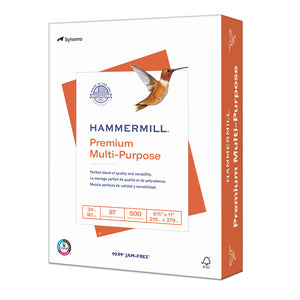
- Single ream, white: Hammermill 105810 (MPN 105810). 1 ream, 500 sheets. Also sold as a 5 ream pack, 105810C, with 2,500 sheets.
- Single ream, white: Hammermill 086710 (MPN 086710). 1 ream, 500 sheets.
- Single ream, white: HP Papers 203000 (MPN 203000). 1 ream, 500 sheets. The 3 ream pack, HP Papers 112300, holds 1,500 sheets.
- Full case, white: Hammermill 103267C (MPN 103267C). 10 reams, 5,000 sheets.
- Tabloid size: Hammermill 105023C (MPN 105023C). 11 x 17 in inkjet printer paper, 5 reams, 2,500 sheets.
For other grades, see Paper Products.
Browse every ream, case and specialty sheet in Copy and Print Paper.
Shop the products in this guide
-

Hammermill
Copy Paper, 1 Ream (500 Sheets), White
MPN 105500
- MPN: 105500
- Size: 1 Ream (500 Sheets)
- Color: White
$18.68
Ships in 1-2 business days
In stock
-
Hammermill
Copy Paper, 1 Ream (500 Sheets), White
MPN 105810
- MPN: 105810
- Size: 1 Ream (500 Sheets)
- Color: White
$35.68
Ships in 1-2 business days
In stock
-
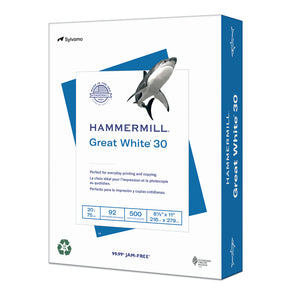
Hammermill
Copy Paper, 1 Ream (500 Sheets), White
MPN 086710
- MPN: 086710
- Size: 1 Ream (500 Sheets)
- Color: White
$24.41
Ships in 1-2 business days
In stock
-
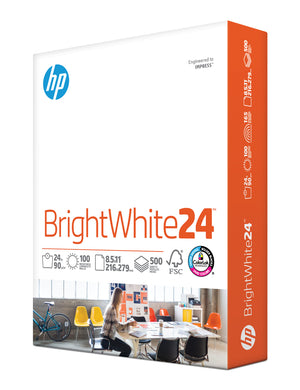
HP Papers
Copy Paper, 1 Ream (500 Sheets), White
MPN 203000
- MPN: 203000
- Size: 1 Ream (500 Sheets)
- Color: White
$28.54
Ships in 1-2 business days
In stock
-
 Pack of 3
HP Papers
Copy Paper, 3 Reams (1,500 Sheets), White, Pack of 3
MPN 112300
- MPN: 112300
- Pack of 3
- Size: 3 Reams (1,500 Sheets)
- Color: White
$47.92
$15.97 / sheetShips in 1-2 business days
In stock
-
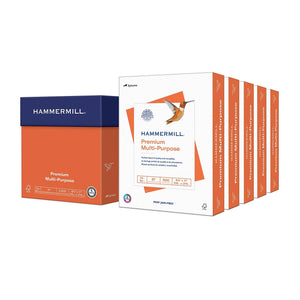 Pack of 5
Hammermill
Copy Paper, 5 Reams (2,500 Sheets), White, Pack of 5
MPN 105810C
- MPN: 105810C
- Pack of 5
- Size: 5 Reams (2,500 Sheets)
- Color: White
$83.57
$16.71 / sheetShips in 1-2 business days
In stock
-
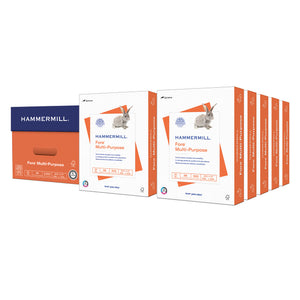 Pack of 10
Hammermill
Copy Paper, 10 Reams (5,000 Sheets), White, Pack of 10
MPN 103267C
- MPN: 103267C
- Pack of 10
- Size: 10 Reams (5,000 Sheets)
- Color: White
$153.00
$15.30 / sheetShips in 1-2 business days
In stock
-
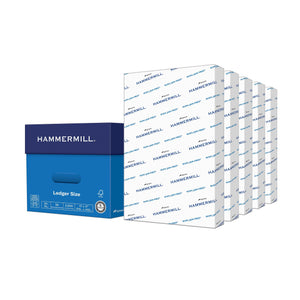
Hammermill
Inkjet Printer Paper, 11x17 5 Reams (2,500 Sheets), White
MPN 105023C
- MPN: 105023C
- Size: 11x17 5 Reams (2,500 Sheets)
- Color: White
$93.60
$133.71Ships in 1-2 business days
In stock


Frequently asked questions
What is standard copy paper weight?
Standard copy paper is 20 lb bond, which is about 75 gsm. It is the everyday weight for copiers, laser printers and inkjet printers. Heavier sheets such as 24 lb (about 90 gsm) cost more but feel thicker and show less print through from the other side. Check the weight on the product page.
What does copy paper weight mean?
Copy paper weight is the basis weight, the weight in pounds of 500 sheets cut to a standard size. For bond paper that size is 17 x 22 in. A 20 lb bond ream is 500 sheets of 17 x 22 in that weigh 20 lb. It is not the weight of the finished ream you buy.
What is the difference between 20 lb and 24 lb paper?
A 24 lb sheet is about 20 percent heavier than a 20 lb sheet, about 90 gsm against 75 gsm. It feels thicker, handles double-sided printing better and suits reports and presentations. The 20 lb sheet costs less and is fine for drafts and internal documents.
What is copy paper weight in grams?
Multiply the bond basis weight in pounds by about 3.76 to get grams per square meter. That makes 20 lb about 75 gsm, 24 lb about 90 gsm, 28 lb about 105 gsm and 32 lb about 120 gsm. These are rounded figures, so a maker's listed gsm can differ slightly.
How much does a case of copy paper weigh?
A case is typically 10 reams of 500 sheets, so 5,000 sheets. Ten reams of 20 lb letter paper hold about 50 lb of paper, and the packaging adds a little. The 10 ream case listed here shows a shipping weight of 51.0 lb on its product page.
Does a higher brightness mean heavier paper?
No. Brightness and weight are separate specs. Brightness measures how much light the sheet reflects, and weight is the basis weight. A 20 lb sheet can be brighter than a 24 lb sheet. Check both numbers if appearance and feel both matter.
Safety
Fire Extinguisher Types and Classes (A, B, C, D, K)
Fire extinguisher types and classes A, B, C, D and K explained, plus ABC vs BC, how to...
Janitorial
Types of Mops: A Guide for Commercial Cleaning
Types of mops for commercial cleaning: wet, dust, flat and sponge, cotton vs microfiber, head weights in oz...
Guide
Grinding Wheel Types: Type 1, 27, Flap Discs and More
Grinding wheel types explained: Type 1, 27, 29, flap discs and wire wheels, plus grains, grit, arbor size...
New guides and deals by email
Buying guides, new products and deals for US businesses.