
Types of Mops: A Guide for Commercial Cleaning
Types of mops for commercial cleaning: wet, dust, flat and sponge, cotton vs microfiber, head weights in oz, color coding and care. Pick the right mop.

In this guide
- Types of mops at a glance
- Wet mop vs dust mop
- String mops: cut-end vs looped-end
- Flat mops and sponge mops
- Cotton vs rayon vs blend vs microfiber
- Mop head sizes: ounces and what they fit
- Buckets and wringers
- Color coding mops by area
- Common mistakes
- Care, laundering and when to replace
- How to standardize and reorder
- Our picks
- Shop the products in this guide
Quick answer: The main types of mops for commercial cleaning are string wet mops, flat mops, dust mops and sponge mops. Wet mops wash, dust mops pick up dry soil first, and flat microfiber mops cover smooth floors quickly.
- Wet mop: cotton or synthetic strings, wrung in a bucket
- Dust mop: dry pickup before washing
- Flat mop: washable pad on a frame, good for smooth floors
- Head size: string heads are listed in ounces of dry weight
- Color coding: a common practice, not a legal requirement
Choosing among the types of mops is mostly a question of floor, area and routine. This guide is for facility and janitorial managers, cleaning contractors and custodial staff who buy mops by the case and want the right head on the right cart. It covers each mop type, the difference between wet mop and dust mop, microfiber mop vs cotton, mop head sizes, color coding, buckets and care. The products named are in the Janitorial Supplies collection.
Shop the 8 products in this guide
Types of mops at a glance
The table shows the common commercial mop types and where each one fits.
| Type | Best for | Note |
|---|---|---|
| Cut-end string | General wet mopping | Ends are cut and open |
| Looped-end string | General wet mopping | Looped ends resist tangling |
| Flat mop | Smooth floors, large areas | Washable pad on a frame |
| Dust mop | Dry dust and debris | Use before washing |
| Sponge mop | Small spaces, spot jobs | Squeezes dry by hand or roller |
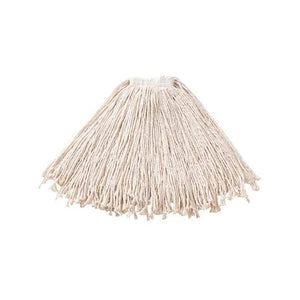
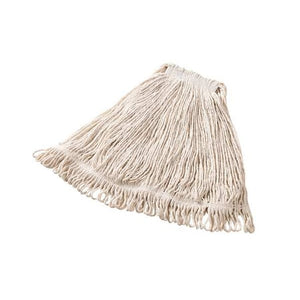
Store listings name the end style and the material for each head, so you can filter by what you read here. For example, the Rubbermaid Commercial FGF11700WH00 is a cut-end cotton string wet mop, and the FGD11306WH00 is the looped-end cotton version.
Wet mop vs dust mop
These two are often confused, but they do different jobs.
- Wet mop. Used with water and a cleaner to wash the floor. The head is dipped, wrung and passed over the floor.
- Dust mop. Used dry, or with a dust mop treatment, to collect dust and loose soil. It is not wrung and it is not meant to carry liquid.
The usual order is dust first, then wet. Pulling loose grit off the floor first keeps it out of the wet mop head and the bucket water, so the wash water stays usable longer. A wet mop used on a gritty floor pushes soil around instead of removing it.
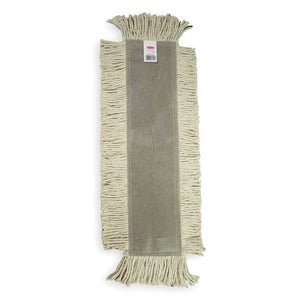
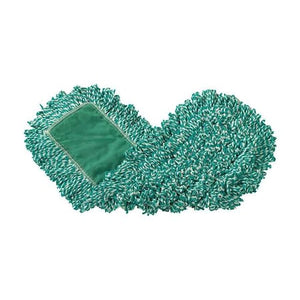
Dust mops come in different lengths and head styles. The store lists 24 in and 36 in heads, among others. The Rubbermaid Commercial FGL15300WH00 is a 24 in cut-end cotton dust mop, and the FGJ85300GR00 is a 24 in looped-end microfiber dust mop. Both slide onto a frame.
String mops: cut-end vs looped-end
String wet mops are the standard commercial wet mop.
- Cut-end. The strands end in open cuts. They are absorbent and easy to wring but can tangle and shed over time.
- Looped-end. The strands are looped back, which tends to reduce tangling and fraying at the ends.
Both fit on a mop handle through a clamp, slide-on or similar connection, so check that the head connection matches your handle before you order. Handle and head connection types are in the product title.
Flat mops and sponge mops
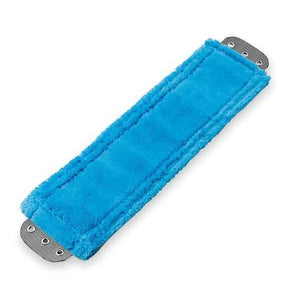
A flat mop pairs a frame with a removable pad. Pads are often microfiber and are laundered and reused. Flat mops are common for smooth floors and for crews who want a lighter tool. The Unger MM40B is a 16 in flat mop pad in microfiber with a clamp-on connection.
A sponge mop uses a sponge head squeezed by a lever or roller. It suits small rooms and spot jobs. For large areas or textured floors, a string or flat mop is usually a better fit.
Cotton vs rayon vs blend vs microfiber
Head material changes how the mop absorbs, how it launders and how long it lasts. This table is a general guide. Check each listing for the actual material.
| Material | Typical use | Consider |
|---|---|---|
| Cotton | General wet mopping | Absorbent, familiar |
| Rayon | General wet mopping | Manmade cellulose fiber |
| Blend | Mixed use | Cotton with synthetic fiber |
| Microfiber | Smooth floors, fine soil | Wash and reuse |
If you are comparing microfiber mop vs cotton, think about routine rather than a winner. Cotton string heads are a common choice for general wet mopping and hold liquid well. Microfiber heads and pads are often chosen for fine soil on smooth floors and are meant to be laundered and reused. Synthetic and polyester heads also appear in the catalog. Many sites run both: cotton for heavy wet jobs and microfiber on routine smooth-floor rounds.
Mop head sizes: ounces and what they fit
String wet mop heads are sized by dry weight in ounces. In the store, string heads are listed from 12.8 oz to 32 oz dry weight, with 16, 20, 24 and 28 oz among the common sizes. A heavier head holds more liquid per dip but is harder to wring and heavier to push, so it is not automatically better.
- Lighter heads (around 12.8 to 18 oz in our listings). Easier to wring and handle, which suits small rooms and lighter use.
- Heavier heads (20 to 28 oz). Hold more, which suits larger areas and wetter jobs.
Treat these as general guidance. There is no single industry rule that matches a head weight to a room size. Match the head to your wringer: wringers often list a head weight range, such as 10 to 32 oz on some listings, so confirm the range on the wringer you use.
Flat mop pads and dust mops are sized by length instead, such as a 16 in pad or a 24 or 36 in dust mop. Pick the length by the area you clean and the frame you own, since the pad or head must match the frame.
Buckets and wringers
A bucket and wringer set holds the cleaning solution and wrings the head out. Two things matter: capacity and press style.
- Capacity. Store listings show 6 1/2, 7 3/4 and 8 3/4 gallon buckets, among others. A larger bucket means fewer refills but a heavier load to move.
- Press style. Side press and down press (and reverse press) change how you apply force to wring the head.
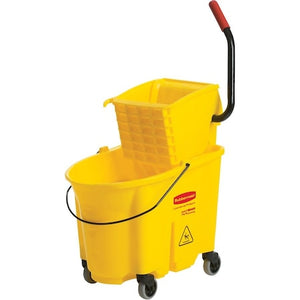
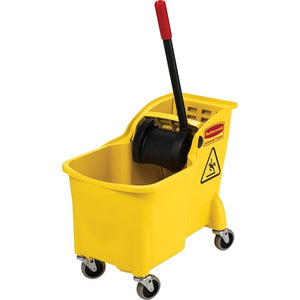
The Rubbermaid Commercial FG758088YEL is an 8 3/4 gallon side press bucket and wringer, and the FG738000YEL is a 7 3/4 gallon unit with a reverse press. Change the water when it turns dirty. Clean water on a clean head is what leaves a floor clean.
Color coding mops by area
Many facilities assign mop colors to areas, such as one color for restrooms and another for kitchens or general floors. This is a common practice used to reduce cross-contamination. It is not a law, and there is no single required color scheme, so set your own and write it down.
- Pick a scheme that your crew can remember, and post it on the cart.
- Keep each color with its own bucket, head and handle where you can.
- Do not move a restroom head to a kitchen because it is the one on the shelf.
Rubbermaid and other makers sell buckets and heads in several colors, so the color is usually part of the part number.
Common mistakes
- Wet mopping a gritty floor. Dust mop first.
- Using one head everywhere. Separate by area.
- Wrong connection. A head that does not fit the handle is a wasted order.
- Mismatched wringer. An oversize head can strain a wringer.
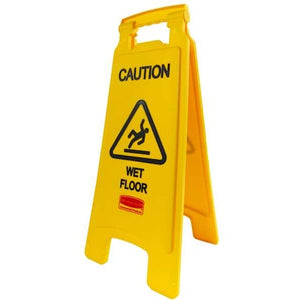
- Mopping with no warning. Post a wet floor sign. OSHA's walking-working surfaces rule asks that floors be kept clean and, to the extent feasible, dry (29 CFR 1910.22). The Rubbermaid Commercial FG611277YEL is a 25 in caution wet floor sign.
For picking the cleaner that goes in the bucket, see our guide on industrial degreaser vs all-purpose cleaner, and browse Floor Care for floor products and Cleaning Chemicals for the cleaner. For liners on the same cart, see trash bag sizes.
Care, laundering and when to replace
- Rinse after use. Do not leave a head sitting in dirty water.
- Launder as the maker directs. Cotton and microfiber heads may have different instructions, so read the label.
- Dry fully. A head stored wet can smell and break down faster.
- Replace when it is frayed, sheds fibers, smells after washing, or no longer absorbs or picks up soil. There is no set number of washes for every mop.
How to standardize and reorder
Pick one head type and size per job, write the part numbers on a cart list, and reorder by MPN. That keeps heads, frames and buckets compatible. To reorder by part number, use Quick Order. Orders of $79 or more ship free. Orders placed by 2 PM ET on a business day ship in 1-2 business days.
Our picks
- Cut-end cotton string wet mop: Rubbermaid Commercial FGF11700WH00 (MPN FGF11700WH00). A general wet mopping head at 20 oz dry weight.
- Looped-end cotton string wet mop: Rubbermaid Commercial FGD11306WH00 (MPN FGD11306WH00). 18 oz dry weight, pack of 6.
- Microfiber dust mop: Rubbermaid Commercial FGJ85300GR00 (MPN FGJ85300GR00). 24 in, looped-end.
- Flat mop pad: Unger MM40B (MPN MM40B). 16 in microfiber.
- Bucket and wringer: Rubbermaid Commercial FG758088YEL (MPN FG758088YEL). 8 3/4 gallon side press.
Browse every head, frame and bucket in Janitorial Supplies.
Shop the products in this guide
-
Rubbermaid Commercial
1 in String Wet Mop, 20 oz Dry Wt, Slide On Connection, Cut-End, White, Cotton
MPN FGF11700WH00
- MPN: FGF11700WH00
$11.82
Ships in 1-2 business days
In stock
-
 Pack of 6
Rubbermaid Commercial
1 in String Wet Mop, 18 oz Dry Wt, Slide On Connection, Looped-End, White, Cotton, Pack of 6
MPN FGD11306WH00
- MPN: FGD11306WH00
- Pack of 6
$80.94
Ships in 1-2 business days
In stock
-
Rubbermaid Commercial
24 in L Dust Mop, Slide On Connection, Cut-End, White, Cotton
MPN FGL15300WH00
- MPN: FGL15300WH00
$14.81
Ships in 1-2 business days
In stock
-
Rubbermaid Commercial
24 in L Dust Mop, Slide On Connection, Looped-End, Green, Microfiber
MPN FGJ85300GR00
- MPN: FGJ85300GR00
$40.94
Ships in 1-2 business days
In stock
-
Unger
16 in L Flat Mop Pad, 16 oz Dry Wt, Clamp On Connection, Cut-End, Blue, Microfiber
MPN MM40B
- MPN: MM40B
$30.48
Ships in 1-2 business days
In stock
-
Rubbermaid Commercial
8 3/4 gal Wave Brake Side Press Mop Bucket and Wringer, Yellow, Polypropylene
MPN FG758088YEL
- MPN: FG758088YEL
$123.49
Ships in 1-2 business days
In stock
-
Rubbermaid Commercial
Mop Bucket and Wringer with Reverse Press, 7 3/4 gal Capacity, Yellow
MPN FG738000YEL
- MPN: FG738000YEL
$92.75
Ships in 1-2 business days
In stock
-
Rubbermaid Commercial
Floor Safety Sign, HDPE, Caution Wet Floor, 25 in H, 11 in W, Not Retroflective, Yellow
MPN FG611277YEL
- MPN: FG611277YEL
$31.19
Ships in 1-2 business days
In stock
Frequently asked questions
What are the different types of mops?
The main commercial types are string wet mops (cut-end and looped-end), flat mops with washable pads, dust mops, and sponge mops. Wet mops apply and lift liquid, flat mops suit smooth floors and fast passes, dust mops pick up dry soil, and sponge mops handle small spaces. Choose by floor type and the job.
What is the difference between a wet mop and a dust mop?
A wet mop is used with water or a floor cleaner to wash a floor. A dust mop is used dry, or with a dust mop treatment, to pick up dust and fine debris before washing. Using a dust mop first keeps loose soil out of the wet mop and its bucket.
Which type of mop is best?
There is no single best mop. Cotton string mops are a common general choice for wet cleaning, microfiber flat mops suit smooth floors and tight routines, and a dust mop belongs in front of both. Match the head to the floor, the area size, and how you launder.
Are microfiber mops better than cotton mops?
Neither wins on every job. Microfiber heads are often used for fine soil on smooth floors and are laundered and reused. Cotton heads are a familiar, absorbent choice for general wet mopping. Many sites keep both. Follow the maker's laundering instructions for either one.
How often should mop heads be replaced?
Replace a head when it is frayed, sheds fibers, smells after washing, or no longer picks up soil or holds liquid. There is no fixed number of washes that fits every mop, so check the head after each laundering and keep spares on the cart.
What size mop head do I need?
For string wet mops, sizes are listed by dry weight in ounces, such as the 18 oz and 20 oz heads in the listings below. Heavier heads hold more liquid but are harder to wring. Match the head to your wringer's listed range, and pick flat pad length by the area you clean.
Guide
Trash Bag Sizes Guide: What Size Do You Need?
Trash bag sizes by gallon, with a bag dimensions chart, how to measure your can and mil vs micron thickness.

Janitorial
Industrial Degreaser vs All-Purpose Cleaner for Shops
Industrial degreaser vs all-purpose cleaner explained for shops and facilities.
Janitorial
How to Choose Nitrile Gloves for a Facility
How to choose nitrile gloves for a facility: pick thickness by task, size by crew, pack size by...
New guides and deals by email
Buying guides, new products and deals for US businesses.