


How to Choose Lab Testing Equipment for a Small Facility
BlinkGoods TeamQuick answer: To choose lab testing equipment for a small facility, start with the measurements you run every week, decide how accurate each one has to be, and then check what it costs to keep each instrument calibrated and supplied. Buy the instrument that covers your most frequent test first, add glassware and consumables that match it, and put your safety paperwork in place before the first chemical arrives.
This guide is for facility managers, QC leads and maintenance departments building or upgrading a small test bench. Every product named below comes from our Lab Testing collection, and the specs we quote come from the product listings. Where a listing does not state a figure, we do not supply one.
Start with the test, not the catalog
A common way to waste money on laboratory equipment is to browse first and decide later. The instrument looks right, arrives, and turns out to measure something slightly different from what the job needs.
List the measurements you run each week
Write a plain list. Water treatment staff might check pH and salinity. A small manufacturer might check solution concentration on incoming material. A school lab might need a way to look at specimens. A maintenance department might only need to confirm that a cleaning solution is mixed to strength.
Each line on that list becomes one instrument, one kit or one piece of glassware. A test you run only now and then may be better served by a test strip or a kit than by a meter you have to maintain.
Required accuracy versus nice to have
Write down the tolerance your process or your customer actually requires. If an instrument reads to within a few tenths of a percent and your spec is a few percent, the extra accuracy is not buying you anything. If the reverse is true, a pocket tool will not do.
Look for the stated accuracy on the product page. For example, the REED Instruments R9600 salinity refractometer lists a 0-28% range with automatic temperature compensation (ATC) and an accuracy of +/-0.2%. That is a specific, checkable number, and it is the kind of line to compare across any two lab instruments.
Core instruments for a small facility
pH meters and test kits
A digital meter gives a numeric reading and is quick for repeated checks. A test kit costs less up front and suits an occasional check where a meter is more than you need.
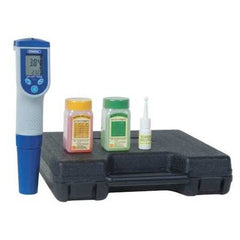
Both routes are in the collection. The General Tools DPH7011, the REED Instruments R3500 and the Triplett PH180 are pH meters. The LaMotte 5858-01 is a pH water quality test kit. Compare probe details, resolution and included accessories on each product page before deciding, or ask us if a listing does not state them.
Refractometers
A refractometer measures a liquid by how it bends light, and it reads from a small sample. The two we list here are the REED R9600 (salinity) and the Test Products International 395. Check the scale on the instrument, because a refractometer reads only the scale it was built for.
Microscopes
For schools, and for a plant that needs to look at fibers, particles or small parts, a stereo microscope is the practical choice. The Barska AY13116 is a student stereo microscope with 20x and 50x magnification. It suits teaching and basic inspection. Specialized imaging is a different budget and a different conversation.
Glassware, beakers and consumables

Beakers, pipettes, hydrometers and thermometers are where lab supplies turn into a repeat purchase. The United Scientific UN3007-1000 is a 1000 mL stainless steel beaker. The Lab Testing collection also carries pipettes, hydrometers and thermometers for daily work.
One practical note: standardize on one beaker material and a short list of sizes. A bench full of odd volumes makes it harder to notice when something is missing.
Accuracy, calibration and traceability

An instrument is only as good as the last time it was checked. Before you buy, ask three things of any listing or manufacturer:
- What calibration does the instrument need, and how often?
- Are the calibration solutions or standards sold separately?
- Can the maker document traceability for the instrument?
NIST uses the international definition of traceability: a property of a measurement result that relates it to a reference through a documented, unbroken chain of calibrations, each of which contributes to the measurement uncertainty (NIST, Traceability). If a customer or auditor will ask you to show that chain, buy from makers who can supply the paperwork. If nobody will ask, a recorded in-house check against a known standard keeps your own process honest.
Instrument types compared
| Instrument type | Spec to read first | Recurring needs |
|---|---|---|
| Digital pH meter | Accuracy, resolution, probe type | Calibration, probe care |
| pH test kit | Range covered | Reagents |
| Refractometer | Scale, range, accuracy, ATC | Clean prism, periodic checks |
| Stereo microscope | Magnification | Cleaning and care |
| Beakers and glassware | Material, capacity | Replacement |
| Thermometers and hydrometers | Range, resolution | Verification against a reference |
Safety and housekeeping for a small lab
Two OSHA standards matter before the first bottle comes in. We link them through Cornell Law's Legal Information Institute; the official osha.gov or eCFR versions can be used for the authoritative text.
- Laboratory standard, 29 CFR 1910.1450. It applies to employers engaged in the laboratory use of hazardous chemicals, and paragraph (e)(1) calls for a written Chemical Hygiene Plan (29 CFR 1910.1450).
- Hazard Communication, 29 CFR 1910.1200. Paragraph (g)(8) requires the employer to keep safety data sheets in the workplace, readily accessible to employees during each work shift (29 CFR 1910.1200).
We cannot tell you whether your bench falls under either rule. Read the text, or ask a safety professional, and then stock accordingly: gloves, safety glasses and spill containment are the usual items to have at the bench. Our guide to choosing nitrile gloves for a facility covers the glove side, and the degreaser versus all-purpose cleaner guide is useful when you standardize chemicals and keep their SDS together. For meters and gauges used around the rest of the facility, see Test Instruments & Gauges.
How to choose: an 8-point checklist
- Write the weekly measurements and the tolerance each one needs.
- Choose the simplest tool that meets the tolerance (kit, strip or meter).
- Read the accuracy, range and resolution on the product page, not the headline.
- Confirm what calibration the instrument needs and who supplies the standards.
- Decide handheld or bench by where the readings happen.
- Add glassware and consumables for the same tests, in as few sizes as possible.
- Put the Chemical Hygiene Plan question and the SDS location on the project list.
- Reorder by part number so a substitute never sneaks in.
Our picks
These are listings in the Lab Testing collection. Prices change, so check the product pages for current pricing.
General Tools DPH7011 digital pH meter. Listed as a digital pH meter. View the DPH7011.
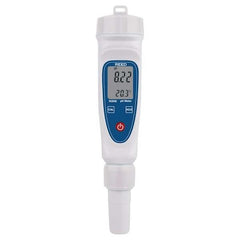
REED Instruments R3500 pH meter. Listed at 40 5/8 mm wide by 185 3/8 mm high. The listing title gives dimensions only, so check the product page for probe and accuracy details, or ask us before ordering if they are not shown. View the R3500.
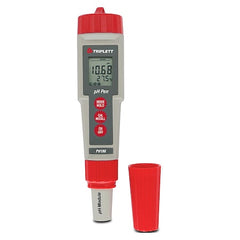
Triplett PH180 pH meter. Listed as a pH meter, 38 1/8 mm wide by 198 1/8 mm high. Compare it with the DPH7011 and R3500 before ordering. View the PH180.
LaMotte 5858-01 pH Water Quality Test Kit. For occasional water checks where a kit is enough. View the 5858-01.
REED Instruments R9600 salinity refractometer. Range 0-28% with ATC and a stated accuracy of +/-0.2%. View the R9600.
Test Products International 395 refractometer. The listing names it a refractometer without stating a scale, so confirm the scale matches your fluid before you order. View the 395.
United Scientific UN3007-1000 stainless steel beaker, 1000 mL. A beaker for mixing and sampling. View the UN3007-1000.
Barska AY13116 student stereo microscope, 20x and 50x. A teaching and basic inspection scope. View the AY13116.
If you are stocking a new bench from scratch, use Quick Order to enter part numbers directly, apply for a business account (Net-30 terms are available for approved business accounts), or ask for a bulk quote. Browse everything in the Lab Testing collection.
Sources
- OSHA Laboratory standard, 29 CFR 1910.1450 (shown via Cornell LII)
- OSHA Hazard Communication, 29 CFR 1910.1200 (shown via Cornell LII)
- NIST, Traceability
Products in this guide
-
-
REED Instruments
REED Instruments R3500 pH Meter, 40 5/8 mm W, 185 3/8 mm H
MPN: R3500
$115.55Sold as: EachIn stock -
Triplett
Triplett PH180 pH Meter, 38 1/8 mm W, 198 1/8 mm H
MPN: PH180
$139.19Sold as: EachIn stock -

Frequently asked questions
Do I need a Chemical Hygiene Plan for a small lab?
OSHA's Laboratory standard, 29 CFR 1910.1450, applies to employers engaged in the laboratory use of hazardous chemicals, and paragraph (e)(1) requires a written Chemical Hygiene Plan. Whether your bench counts as a laboratory under that definition is a question to settle against the standard itself or with your safety consultant.
What does calibration traceability mean on a lab instrument?
NIST uses the international definition of traceability: a property of a measurement result that relates it to a reference through a documented, unbroken chain of calibrations, each contributing to the measurement uncertainty. In practice, ask whether the maker or a calibration lab can document that chain for the instrument you are buying.
Should I buy a benchtop or a handheld pH meter?
Decide by where the readings happen. A handheld meter travels to tanks, sinks and sample points, while a meter used at one bench can stay put. Compare the accuracy, resolution and probe details on each product page, because those differ by model and we do not assume them. If a listing does not state them, ask us before you order.
Where do I keep safety data sheets for lab chemicals?
Under OSHA's Hazard Communication standard, 29 CFR 1910.1200(g)(8), the employer keeps copies of the safety data sheets in the workplace and makes them readily accessible to employees during each work shift. The rule allows paper copies or electronic access, as long as nothing gets in the way of immediate employee access in each workplace.
What is the difference between lab supplies and lab instruments?
Instruments measure something, such as a pH meter, refractometer or microscope, and need calibration or care. Supplies are the glassware, beakers, test strips and kits you use up or replace. Budget for both, because consumables are a recurring cost that a one-time instrument purchase hides.